Monday, April 21, 2014
Film Screening of "Cambodian Son" on April 27!


Asian American Arts Centre is excited to co-sponsor the screening of Cambodian Son, winner of "Best Documentary" at the San Francisco CAAMFEST 2014. The NYC screening will be held at Mist Harlem (46 West 116th Street) on Sunday, April 27, 2014. This event will include a reception and a Q&A with the director, Masahiro Sugano. Please check the flier below for more information. 

Sponsored by Immigrant Defense Project, Families for Freedom, & Asian American Art Centre.


Read more
Friday, April 11, 2014
Friday, March 28, 2014
Taiping Tianguo: Revisited


E-Flux recently presented the show Taiping Tianguo - A History of Possible Encounters: Ai Wei Wei, Frog King Kwok, Tehching Hsieh, and Martin Wong in New York. Exploring the histories of these four Chinese artists during their time in New York in the 80s and 90s, the show questions the interactions each artist may have had to one another given their overlapping time spent in the Big Apple. Furthermore, it examines what can be said about time and place in art history, as well as the development of their art practices, when looking at their works together.
Here are some photos from the exhibition:

Young Ai Wei Wei


Young Ai Wei Wei


Young Ai Wei Wei


Young Ai Wei Wei


Young & Nude Ai Wei Wei


Ai Wei Wei - Cuffs


Ai Wei Wei - Hanger


Kwok - detail of artwork


Kwok - detail of artwork

Kwok - detail of artwork


Martin Wong - artwork on book


Young Teh Ching Hsieh


Teh Ching Hsieh - One Year Prison Performance


Walking Tour on Martin Wong
As the exhibition presents, certain connections were forged between the four artists while in New York. For example, Kwok provided significant assistance for Hsieh in his One Year Performances, Wong and Ai had been friends themselves, as well as there being multiple interactions between these artists at KWOK Gallery (Kwok's SoHo gallery at the time). With the early days of contemporary Asian/ Asian American art, it is interesting to take note which artists have crossed paths and through what particular avenues. In addition, it is highly probable that the Asian American Arts Centre, also played a factor in forming the relationships between these important figures. As Bob Lee, AAAC Director, reflects on the interactions these artists had to AAAC:
"I recall Ai Wei Wei rarely came by, only once or twice did I see him hanging around and only later, in 1985 when he participated in an exhibition and helped finalize a poster for the show.  Kwok was around lots, a very friendly fun guy. We did several things with him. We hung around his home/gallery too, before AAAC exhibitions started. Martin was around but only after we had him in an open studio exhibition in 1985. I visited Teh Ching Hsieh when he set up the prison piece... but he rarely came by AAAC, only much later during his 13 year piece did he stop by to see an exhibition of his friend Zheng Liangjie in 2002."


Ai Wei Wei participated in an Open Studio exhibition called Ten Chinatown in 1985 and helped Bob Lee with the layout of the poster.  The design incorporated Martin Wong’s Chinese Opera figures. It was selected by Exit Art for their Alternative Histories exhibition in 2010 as pictured here. Ai Wei Wei's name is printed on the lower right.


While each artist spent a limited time with AAAC, their paths may have crossed or overlapped with one another during their time within this space. Moreover, their interactions were not limited to each other, but developed with other fellow Asian/ Asian American artists that participated in the Asian American Arts Centre. Such is a possibility in AAAC's first panel discussion in 1983, Eye to Eye, which brought together Asian American visual artists on the East Coast to discuss mutual concerns. It was given the name to imply that a meeting of the mind was necessary to recognize what was happening between two cultures, two outlooks. In these old pictures of the panel below, there looks to be a man that may be Teh Ching Hsieh. Though it cannot be entirely sure that this was him, these photos still give proof to the pertinent interactions of Asian American artists and their solidarity in the beginning stages of the Asian American Arts Movement. 

It is intriguing to think about the crossing paths of Ai WeiWei, Teh Ching Hsieh, Martin Wong or Kwok Man Ho because they are prominent now. As Asian American art becomes better understood and a critical consensus emerges around its role within a Western context, other artists will acquire attention, and their interrelationships may also become intriguing to think about. 

AAAC's Eye to Eye Panel (1983)Panel: David Diao, Margo Machida, Lucy Lippard, Lydia Okumura, Kit Yin Snyder, John Woo, John Yau


Eye to Eye Audience


Some of the panelists with Bob Lee AAAC curator before the start of the event, including Lucy Lippard, Margo Machida, and Kit Yin Snyder. Kwok's artwork hangs in the back.


Was this Teh Ching Hsieh? Sitting next to Nina Kuo who operated the slide projector. Eye to Eye was held June 25th and Teh Ching Hsieh's year long performance with Linda Montano started in July. The possibility is there.


Was this Teh Ching Hsieh?
Read more
Thursday, August 15, 2013
Monday, May 20, 2013
Saturday, April 27, 2013
no image

On April 24th, Robert Lee attended the Rubin Museum of Art: Brainwave Panel talk where author Lee Smolin and neuro-scientist Warren Meck discussed the elusive understanding of time in regards to the long and diverse history of Asian art.

Here is a glimpse of what Robert had to comment about. The following conversation took place between Robert Lee and D.K Matai over FB.

DK Matai:  "Quantum physics brought us the cell phone, computers and the Internet and is one of the most successful scientific theories put into practice by humankind. It also presents opportunities for a new evolution in our scientific, social and spiritual understanding."

A new worldview begins to emerge via this quantum-centric understanding, embracing the interconnectedness between Humanity and Nature, Earth and Cosmos, Photons and Entanglement. Quantum entanglement occurs when particles such as photons, electrons, molecules as large as bucky-balls, and even small diamonds interact physically and then become separated. There is a correlation between the results of measurements performed on entangled pairs, and this correlation is observed even though the entangled pair may have been separated by large distances. In quantum entanglement, part of the information transfer happens instantaneously. Repeated experiments have verified that this works even when the measurements are performed more quickly than light could travel between the sites of measurement. Recent experiments have shown that this transfer can occur at least 10,000 times faster than the speed of light, which is not to imply that this phenomenon is not instantaneous but it nevertheless sets a lower limit.
Quantum entanglement demonstrates the interconnectedness of the universe; all that is within and without; and it is becoming the centre-piece of advanced research and development in computing, cryptography, telecommunications, healthcare and energy. Its implications are not to be underestimated across all scientific and subjective disciplines.
Quantum phenomena based understanding may finally herald the merger of science and spirituality and take humanity on a new path of consensus rather than confrontation. Do you agree? What are your thoughts, observations and views?


Robert Lee: "Thats a lot to say in so few words. Where can this be read to understand it? Its like the first phrase in a four character childrens Chinese ancient text - "Man is good". A touchstone that needs only consensus. However consensus or conflict is a cultural stance more than a scientific principle and to shift ones values from what one is familiar to values that in technical terms appear to have practical application but in ones bones are as obscure as blindness on the edge of fear. So many walls have been built, Science might pose but it is cultural workers who will make manifest and convince the hesitant and entrenched to take a new path. Ahead the road is still long.
Support arts role in transmitting to our bones a new way of feeling."
Read more
Thursday, April 18, 2013
An Essay on the Art of Mikyung Kim


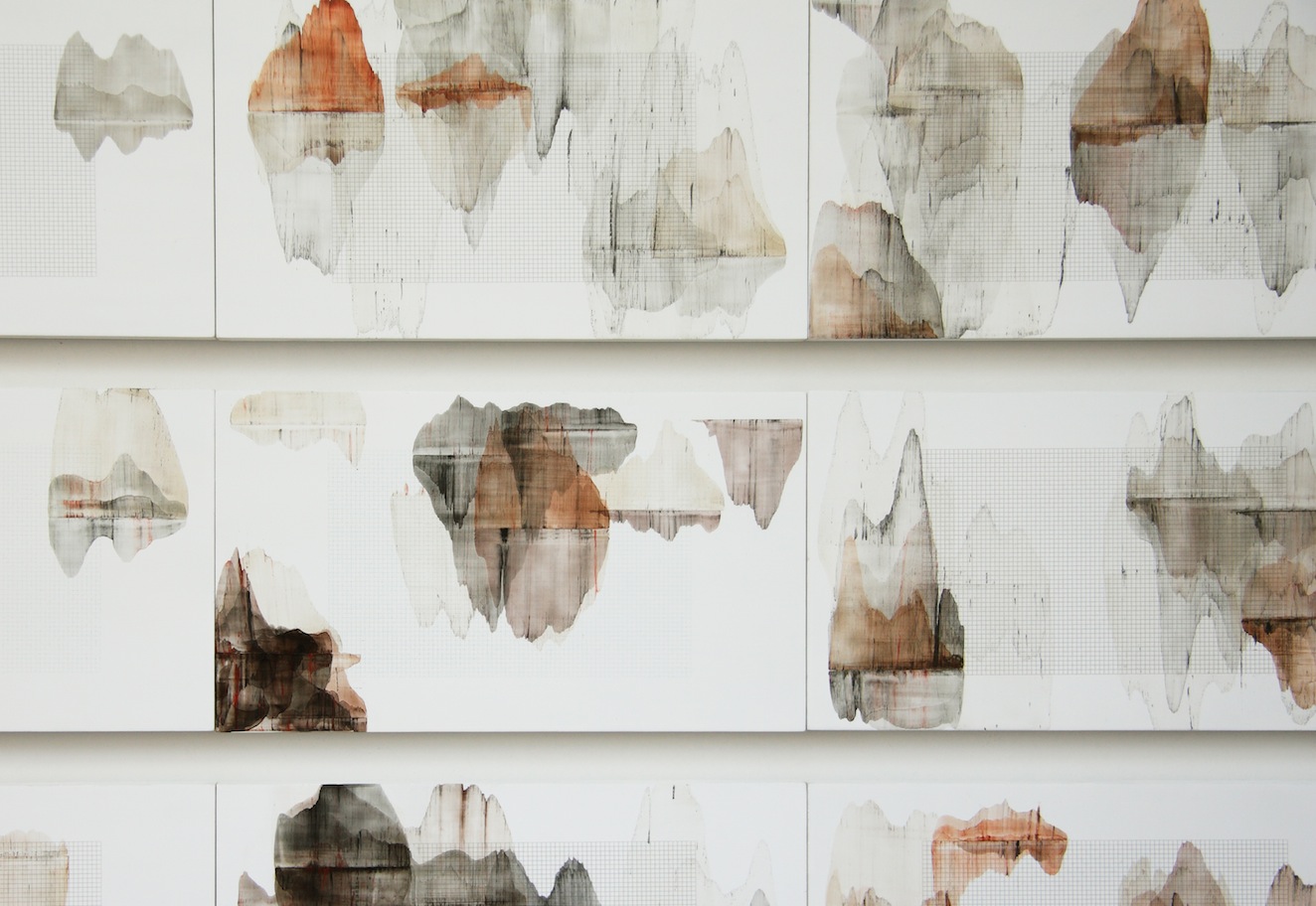
Here are stains of substances carefully modulated on pure white surfaces for their revelatory indications, washes by recipe allowing a latitude of variation along one axis while retaining numerical limits and control of the other elements. A graph-like evidence emerges, layers of a wordless sign, measurements of specific reactions, or are they calculations of specified emotions. Fragments of a landscape or a specimen each embedded into the surface, each panel a recent fossil of a Now moment, perhaps yours…Now.

Nothing hysterical, no explosions, quite the contrary, targeting perceptions, situations normally overlooked, a laser distillation of small perhaps insignificant occurrences, each panel gathered together one by one, with pauses - breathing spaces, to graph the gentle accumulation of our collective days.


Her own collection of days, 280 days to be exact, in one of Mikyung Kim’s calendar works, is the time it takes to gestate a baby. In another work the span of one lifetime – 80 years. Process has become key – the resin dries fast, its mixture with water based inks changes with humidity, the needs of the palette to be regularly refreshed, the size of tools - straight edged palette knife are circumscribed. The time to think is brief. The process becomes ceremony for the surprises and accidents to be harvested, and later, chose which will be re-possessed to start again anew.


Mikyung's landscapes of the mind reinvent a way to see, a path to avoid what has become stale, and what is merely a technological innovation, to bring us closer to what is vital. Aesthetic leadership.

Recognize art -- its central role. Pushing beyond secular notions of art as secondary in a system that monetizes everything under the sun. A new notion of what is nearly – but never acquires the color - ‘sacred’. To perceive what is truly of value – a basis for changing our ways. The current system is not sacrosanct. It can be changed, just as Mikyung Kim has changed.

As a sculptor of installations she explored metaphysical games in public space as they passed imperceptibly into private if not cosmic space. Now the grit and urgency of time creates an elegant validity for perceiving and recognizing what is real, what is remarkable, the pulse of our days as we chose to live them. A language of orderly patience, gentle joys, and engaged surprises.


Support ethical leadership. Power is not the way. Another form of leadership is necessary to move us out of the power arrangements of the post WWII era. If Mikyung Kim’s art can give us a measure of being human, and if man is not the measure of all things, and never was, then all this, has it just been an excuse to continue in disguise the bellicose traditions of nomadic Europe? Infecting all forms of civil life while sanctioning seductions to power?

In the space between cultures, Mikyung Kim, an Asian American artist, see the changes we feel, the miniscule increments that tic by obscurely, see the rippling fusing conjoining before us, this moment, our moment.

Midst the monumental architecture of our ambition, in the interstices of capital, attention for detritus thrives. Content with seeming insignificance, small rituals, unknown observations hum, the oil of our time.

Robert Lee
April 26, 2012


Read more
Friday, December 7, 2012
Division St. and Bowery Nov 1

Nov 1 Thursday in the midst of the downtown blackout the city looked quite different at night. 
This is the Bowery in front of Confucius Plaza with only the lights from the cars.
Traffic lights were not working, police had to be there to control traffic approaching Manhattan Bridge. 
Traffic on Division St was all jammed up


At night on Division St people hung around outside talking, as in many parts of the city below 34th St.
Lucky it was not cold yet.

Also on Division St past Allen St I was lucky to find a bar open at 8pm that still offered hamburgers, else there was nothing to eat in Chinatown.

Such a friendly place, 


Read more