
.png)

T o o F a r T o o C l o s e: 24 y e a r s l a t e r
-
 June 27, 2024
-
 0
comments
0
comments
 June 27, 2024

Below find two articles, one is by Hitomi Iwasaki written for AAAC and Korea Society.
24 years ago in Sept 2000. The other by myself also published in Korea Society Quarterly at that time. Both synchronistically found recently, a forgotten perspective for me on an essential aspect of AAAC ‘Annual’ exhibition program through the 90s, why it was important and why it became a default or taken-for-granted aspect, resisting the criticisms that led to Senator Jesse Helms attacks. A moment in time when Asian American/Diaspora art had little entry into the mainstream we buckled down to establish a history & a track record. The Annual series was key to that position. Korea Society in partnering with AAAC sought a potential opening for its own contemporary artists. Written with a sense of its past historical changes begun in 1985 into its potential prospective future moment.

Published with Hitomi Iwasaki’s astute article on the issues of identity and its complex permutations. Insightful on the perspective of major cultural institutions even convincing except 24 years later after the renewal of anti-Asian Violence the term “Asian American” has revived and its assertion as a rallying cry as well as a refuge much needed in these times. This is the post-pandemic era but more so society’s seemingly invisible estrangement from the earth has broadened from a 60s sensibility to an international recognition of a feature of the West for five hundred to a thousand plus years.
Stephen Jenkinson (author of Die Wise) expressed it this way: “We are children of strange times. Our birthmarks are both troubled and troubling. We do not, most of us, belong. We inhabit, we own, instead. Being in the world but not of it: that was once a foundation of Western spirituality. It will end up being a stain by which we will be held in disrepute. Our way with the land entrusted to us bears the marks of our unbelonging….”
‘Asian American’; came to be adopted at AAAC to set ourselves opposed to the Vietnam War but also apart from the sensibility, the tacit manner of the hubris that claimed us as other. This opened a space where we could seek friends, allies and an art for a different world. And be a site of refuge for our community.
I wonder if mainstream institutions are now more receptive to contemporary Asian or what I would call Asian American art, how would this shift be understood?
Bob Eng Lee June 2024
In a Perfect World (Different Americans/Different Asians)
Hitomi Iwasaki
Originally published in Korea Society Quarterly Sept 2000
Together with 2 Far 2 Close & The Annual Series of Exhibitions by R. Lee
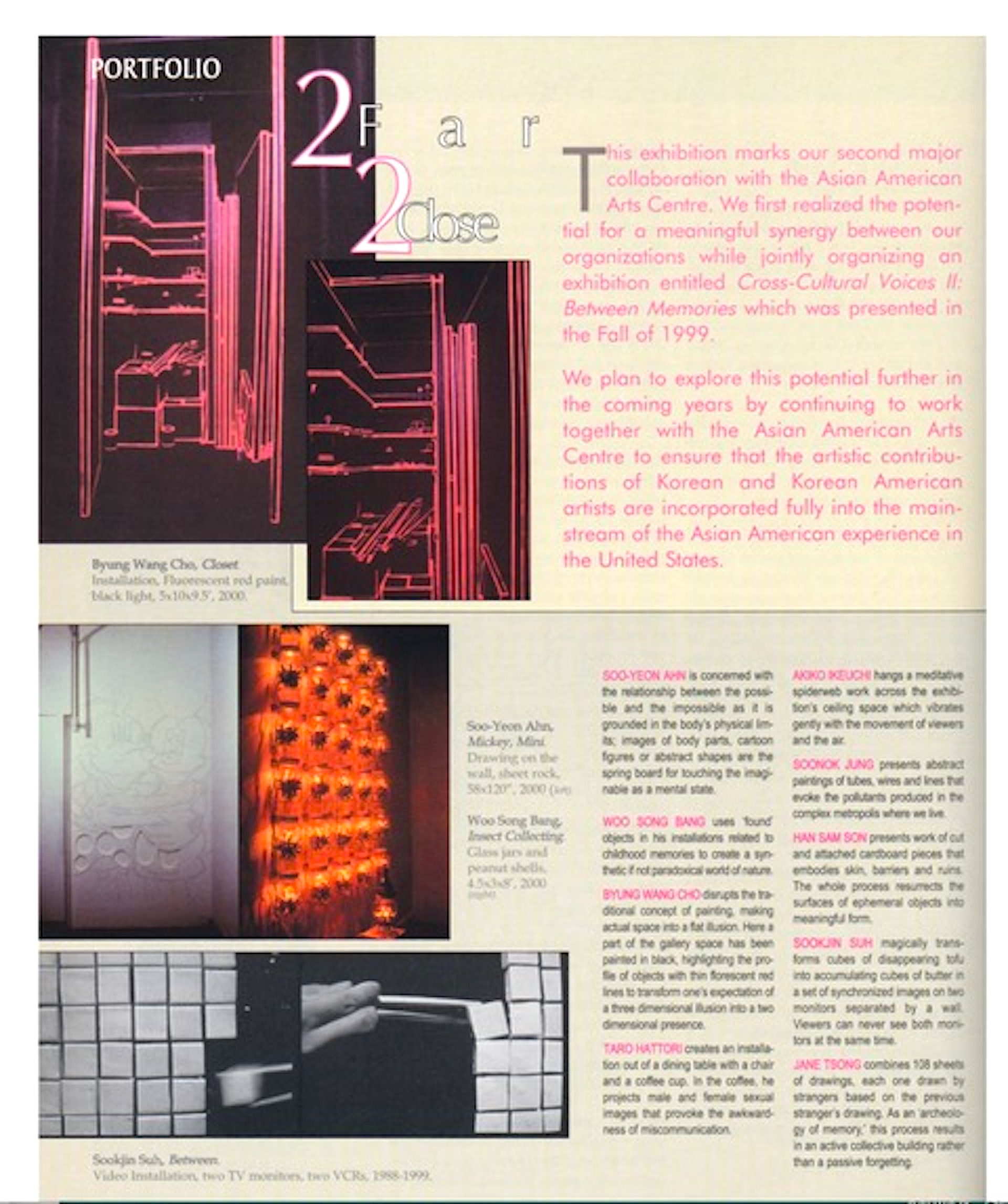
A parade of large-scale exhibitions of Asian contemporary art passed through major New York institutions in the 1990s: Against Nature: Japanese Art in the Eighties (1990), Across the Pacific: Contemporary Korean and Korean American Art (1993), Asia/America: Identities in Contemporary Asian American Art (1994), Traditions/Tensions: Contemporary Art in Asia (1996), Inside out: New Chinese Art (1998), Out of India: Contemporary Art of the South Asian Diaspora (1997), and Cities on the Move (1998). As timely responses to the evident sociopolitical changes, these exhibitions strove to demystify Asian exoticism for Western viewers. In various degrees, exhibition organizers, including invited curators from Asia, carefully eschewed stereotypical designations. Many of the artists chosen to participate were given space at these major venues virtually for the first time. The ethnically based exhibitions naturally invite the viewer’s expectations of inherent eccentricities in the works from non-Western countries. Ultimately, the critical reception to such exhibitions always involved the debate over whether the works were too derivative of Western trends and inauthentic, or, too ethnic to pass muster against the contemporary art yardstick.

In the wake of postcolonial ideology, the West’s attention to “others” has shifted gears, and is seen as an attempt to stimulate a seemingly exhausted Western art history in the Modern and Postmodern lineage. Both the capacity and the need to bounce the Western self-concept off of something else, to set a point of reference, became profuse. It is crucial to note the subtle difference from the arguments in “Orientalism”—that the notion of the orient was a mere reflection of European arrogance and Western prejudice—as discussed by such authors as Edward Said. The realities of globalization and information technology update the East-West gap from one of civilization hierarchy to that of cultural difference. And while this is not an attempt to make a haphazard equation between the issue of Orientalism and the current proliferation of Asian or “non-white” contemporary art, the discussion of the subject has certainly illuminated some of the operative complexities of the climate cued by such buzzwords as multi- or trans-culturalism, globalization, and nomadism. The manifold intricacies become even more complex as one takes into account cultures fostering other cultures within, as in the case of numerous immigrant groups, including that of the diverse Asian Americans, contained within a vast nation such as the United States.
Being indigenous neither to “America” nor to “Asia”, Asian American artists have yet to be comfortably positioned in an international art scene that has of late championed artists of Asian origin. This is precisely due to the geographical uncertainty of their cultural identity, embodying an ill-fitted culture within another culture. The title of the exhibition organized by the Asian American Arts Centre, 2 Far 2 Close, zeroes in on this dilemma. As a community-based organization, the Centre was founded in 1974 with its commitment to promote the preservation and creative vitality of Asian American cultural growth through the arts and its historical and aesthetic linkage to other communities. The dilemma doubles when we realize the Centre’s mission has been to address the distinctive concerns of Asian Americans in the United States that go in two directions both within the very community itself and to the larger society. There is a difficult paradox in the simultaneous pursuit of preservation and assimilation. The Centre’s effort has always been to embrace the shifting state of “Asian American-ness”. The artists represented in the current exhibition 2 Far 2 Close reflect this posture by including nomadic/diasporic “Asian Asian” artists who recently moved from their native countries and have chosen to be based in the United States but reside here semi-permanently. The Centre’s programs have been all inclusive in this sense from the very beginning of its exhibition programs begun in the mid-1980s.

The construction of identity in every age and every society involves establishing opposites and “others”. As Said maintained, “the development and maintenance of every culture require the existence of another different and competing alter ego.” An individual’s self-concept emerges often when one recognizes oneself as separate and different from others. Cultures need to go through an analogous process and so must identify themselves through an alter ego. In other words, the need for an “other” is built into human nature at both the individual and collective levels. Now that the geographical border of culture is becoming rapidly fluid, the act of reaffirming cultural identity seems increasingly complex.
I have a vivid recollection of my own embarrassing and naïve surprise at my first encounters with Asian Americans when I arrived in the United States about a decade ago. They look Asian just like myself, but have Western first names, speak English without the slightest accent, and might be incapable of reading Chinese haracters. This unexpected and beguiling “foreign-ness” I felt from them was much greater than that of other Western people of different races. More than anything, this was “the” culture shock of my coming to America. It is imperative to recognize the sheer relativity of what appeals as exotic or different and to whom. As cultures increasingly fracture, the identity of the individual becomes further hybrid. And this hybridization of cultural identity is evidenced not only by artists, but also by art professionals who institutionalize it, and by the public whose embrace or rejection of it feeds the cycle of production--whether towards radical or mainstream ends.
AAAC’S ANNUAL SERIES OF EXHIBITION
By Robert Lee
Executive Director Curator, Asia American Art Centre

The Annual series of exhibitions began modestly, as a reformulation of a series started five years earlier entitled, "Ten Chinatown: First Annual Open Studio Exhibition." Five of these Open Studio exhibitions were held. Thus the Annual series is actually sixteen years in the making. The series was changed when, after five years, too few artists had their studio in the neighborhood and the idea for the annual exhibition had to be changed. How then write about the Annual series as an Arts Centre endeavor? Judging from hindsight may render one useful perspective.
The role of the Annuals/Open Studios in the Asian American Arts Centre's visual arts program was an opportunity to exhibit many artists, often quite diverse, eclectic, and innovative. It was, however, only one part of a larger effort to bring attention to a particular kind of artist who, we believed to a large measure had been overlooked. The work of AAAC began with visual artists in 1982 with the start of the Archive. This work was shaped in 1974 when the organization was named "Asian American" and again in 1984 by identifying artists as "Asian American". In this way we sought to raise the visibility of the presence of difference. Some of the artists in the first Open Studio show were Kunie Sugiura, Arlan Huang, Jerry Kwan, Martin Wong, Zarina Hashmi, Charles Yuen, John Duff and Tom Butter.
In the early 70's the disaffection with government policies, the Vietnam War and the Civil Rights Movement lead to the view that major institutions had left out a piece of American history and were not serving a distinct segment of the population. This demanded of people of color that they uncover for themselves their own story. The history of Asians in America was one of these. The Arts Centre chose to present and explore our community in the Lower East Side of New York. The concept, Asian American art, is both ethnic, cultural and political, a middle ground whose value awaits recognition. Asian American Art is in the middle of a river, so to speak, of political, cultural and artistic complexities. It is a way of looking at art that is not only Asian and not only American nor simply artistic, but a combination of these. Its implications require the choice of a different ethical stance; we chose community action.
"Diverse communities seek to legitimize their perspective on the generic American story. The master narrative of American history can no longer presume a singular cultural perspective, and the process has begun to reconcile the contradictions of its multifaceted populations, and the cultural visions which they embody."
Our moral tone in 1996 was high, and certainly a sense of righteousness continues to be a part of what underlies Asian American art. Participants in the Second Annual Open Studio show included Kazuko, Ai Wei Wei, Prawat Laucheron, Albert Chong, Toshio Sasaki, V.C. Igarta and Nina Kuo. The Arts Centre proposed a different American ethos. Its cultural stance was and is color consciousness, an awareness of self in the context of a cultural past. For once one accepts oneself as such, an individual of color has the basis to accept and embrace other individuals and cultures. Color blindness, an American ethos based on merit and equality, dispenses with difference and the cultural heritages of other peoples. From the Art Centreís view, this is neither desirable nor viable given demographic patterns. The multiple perspectives that now compose the American landscape and the global context can be accepted and recognized as a non-hieratic basis for dialogue and cultural development. Given this perspective, the phrase, 'culturally specific organizations' is a misnomer since for such organizations, specific cultural roots serve as points of departure to see and embrace the whole. In a world that claims universality while implementing market share and turf fights (prime victims of this are fragmented ethnic enclaves) this is criticized as negative separatism and a ghettoization. Yet by initiating this identity, despite efforts to dismiss it, the question of difference has grown to become one of the many ambiguities the contemporary world lives with, and a point of departure to shape a more viable society.
Our effort to establish a place for Asian American artists and their work helped exerted pressure on mainstream institutions to change and make the American public aware of cultural developments in Asian American communities if not those in Asia. Cultural activities in ethnic communities routinely were ignored; the public knew nothing and could know nothing of the press blackout on so-called race based exhibitions. The national effort to assimilate or be inclusive of minorities and/or sheer ignorance kept this policy in place. When major institutions finally recognized these developments and then adopted them in the early 90s, it was seen in Hispanic, African and Asian communities as the appropriation of the mission, program, and funding of community art organizations. This is partly why most diverse community institutions did not grow to mid size or become institutionally stable. Some of the artists in the Fifth Open Studio show were Arleen Schloss, April Vollmer, John Allen, Toyo Tsuchiya, Rashid Arshed, Paul Wong, Ken Hiratsuka and Hilda Shen.

What was it like in the early years? Its promise of growth, the energy of righteousness, the support and encouragement we received, Dance Theatre performers rehearsing in the next room, we were a start up with no where to go but up. It was a joyous time, full of energy, borne by faith and enthusiasm. The long haul set in when funds were cut, supporters got jobs, married and left, The idealism of the 60's had past, and the thrill of the 70's with all of Chinatown's new groups began to settle. In the arts if it wasn't resistance from Asian American political groups, it was the label of ethnic separatism that claimed it was unsightly, even un-American to put quality second behind race. For such critics, the story of ethnicity could not possibly be synonymous with the story of serious contemporary art. Participants in the AAAC Annual 1990 included Kip Fulbeck, Henry Cainglet, Kwang S. Lee, Sui Ying Hung, Stanley Nishimura, Sui-Kang Zhao, Lalitha Ananthanaman and Julia Nee Chu.
With the fading of the Asian American movement, with the obscurity and irrelevance contemporary art held for the survival issues of most Asian American families, without news coverage in the major New York press, enclave containment was as debilitative or more so as the blockade of Cuba. And our response was similar - to entrench our community ethics and make frugality a value instrumental in effectively and persistently making Asian American art a permanent if microcosmic fixture on the fringe of the City. Without, as one "chuppy" expressed it, critical mass, and shedding the conventional ideas of what it means to make it in New York, we sought to amass a history, an Archive and a track record of the presence of Asian American art for later generations to build on. Without a marketing budget to generate a large audience and thinking being "in", "making the scene" was unnecessary for those who would seek us out. We continued to plug away and do what we knew was right.

In this we were wrong. Being "in" in the capital of commercialism where rumors and hearsay snowball into successful stampedes is crucial in how you are regarded. The incommensurability of the visual arts when the written and spoken word in a hyper-politicized urban environment holds far, far more weight than what is felt. Even the gap between Asian American Studies & Literature and the issues and concerns of the plastic arts infused with Asian American elements remains wide. Without a voice, those on the fringe know well what it means to be neutralized, manipulated, when any other course save towing the line is simply not viable. The dilemma remains as long as powerful elements in America refuse to hear other modalities, insisting on a national identity and a hierarchy that does not give credence to multiculturalism as an important if not defining description of the US. Some of the artists in the AAAC Annual 1992 were Jackie Chang, Hyun-Mi Yoo, Sungmi Naylor, Yoshiko Shimada, Ava Hsueh, Sowon Kwon, Gaye Chan and Ela Shah.
So we dug in further, zeal turned into regularity, burnout turned into savvy, and innocuous community programs maintained a facade that allowed us to continue our focus on Asian American art. By appearing to become undefined, subliminal, even obscure, to promote and establish its presence, not as a threat but as a habit, a given, AAAC sought to be normal, a part of the scheme of things. In this process Asian American art became less an idea, an ideology and more the daily support of the concerns, issues, idiosyncrasies of a multiplicity of artists and their work. Crafting themes provided a context and a history, a critical perspective that, in the light of arts incommensurability, maintains a human voice while the art speaks for itself. The Annuals become theme-less and five person panels formed to select the artists, enabling a gathering where Asian American issues could be discussed. This was the experience of AAAC as we saw and felt it. Asian American art has come a long way since then, accepted now in many quarters. But it has far to go. Its unabashed complexion, obscured increasingly by shortsightedness, a reconciliation between the civilizations of Asia and the West, is inexorable.
A note by the curator Young M. Park in her catalogue essay for “Cross-Cultural Voices” held at Stony Brook states: "In an interview that was done on October 7, 1998, Gao Minglu, the curator of Inside Out at the Asia Society and PS1 mentioned that, although he tried not to choose many immigrant artists since the exhibition is about Chinese art, he had to depend on Asian American artists such as Wenda Gu, Xu Bing, Cai Guo-qiang, Lin Tian-miao, and Wang Peng for the major installation projects. In addition, of the sixty artists participating in the exhibition, seventeen artists reside in or were educated in the West; nine among these seventeen artists are Asian Americans." For many reasons, Asian Americans artists still go under-recognized for their significance in contemporary art developments.
Just as creating an art without relying on the marketplace is possible, so living a committed life dispite American societal conditions, is possible. An engaged life without thought of self gain is still a choice. In chosing the creative side of Asian American communities, how they are pulled apart in a thousand ways becomes obvious. However, to begin to listen and appreciate Asian American voices, is one way to bring them together. AAAC in Chinatown? Yes. Abidding while observing the siege on this crowded enclave, and on the growth nationally of an Asian American consciousness, brewing a body of work that will continue to spawn and feed the urge to create. AAAC programs continue.
What other conclusions can be made about the visual arts program of the Arts Centre and in particular, the Annual series? Judging them with hindsight is useful but ultimately this only creates another perspective, another trajectory, another plan, another conceptualization, another pebble in your shoe. From the past we can look for pebbles or see the ever-present genesis of the present moment. The Annuals are an effort to capture the openness of this moment. “Now” is a privilege happening before our eyes. To resist seeing them as past, to be reluctant to say ultimately what they were or mean is to celebrate them for what they are.
Many artists, since participating in Open Studio/Annual exhibitions, often early in their careers, have done well. Among these the following can be mentioned: Santiago Bose, Jackie Chang, Albert Chong, Theresa Chong, David Diao, Kip Fulbeck, Kenta Furusho, Wenda Gu, Yang-Ah Ham, Zarina Hashmi, May-Ling Hom, Arlan Huang, V.C. Igarta, Jung Hyang Kim, Woong Kim, Kwok Man Ho, Sowon Kwon, Amy Loewan, Toshio Sasaki, Peng Wang, Martin Wong, Paul Wong, Xu Bing, Charles Yuen, Zhang Hongtu, Sui-Kang Zhao.


