Showing posts with label Asian American. Show all posts
Thursday, June 27, 2024
T o o F a r T o o C l o s e: 24 y e a r s l a t e r

Below find two articles, one is by Hitomi Iwasaki written for AAAC and Korea Society.

24 years ago in Sept 2000. The other by myself also published in Korea Society Quarterly at that time. Both synchronistically found recently, a forgotten perspective for me on an essential aspect of AAAC ‘Annual’ exhibition program through the 90s, why it was important and why it became a default or taken-for-granted aspect, resisting the criticisms that led to Senator Jesse Helms attacks. A moment in time when Asian American/Diaspora art had little entry into the mainstream we buckled down to establish a history & a track record. The Annual series was key to that position. Korea Society in partnering with AAAC sought a potential opening for its own contemporary artists. Written with a sense of its past historical changes begun in 1985 into its potential prospective future moment.

Published with Hitomi Iwasaki’s astute article on the issues of identity and its complex permutations. Insightful on the perspective of major cultural institutions even convincing except 24 years later after the renewal of anti-Asian Violence the term “Asian American” has revived and its assertion as a rallying cry as well as a refuge much needed in these times. This is the post-pandemic era but more so society’s seemingly invisible estrangement from the earth has broadened from a 60s sensibility to an international recognition of a feature of the West for five hundred to a thousand plus years.  

Stephen Jenkinson (author of Die Wise) expressed it this way: “We are children of strange times. Our birthmarks are both troubled and troubling. We do not, most of us, belong. We inhabit, we own, instead. Being in the world but not of it: that was once a foundation of Western spirituality. It will end up being a stain by which we will be held in disrepute. Our way with the land entrusted to us bears the marks of our unbelonging….”

‘Asian American’; came to be adopted at AAAC to set ourselves opposed to the Vietnam War but also apart from the sensibility, the tacit manner of the hubris that claimed us as other.  This opened a space where we could seek friends, allies and an art for a different world. And be a site of refuge for our community. 

I wonder if mainstream institutions are now more receptive to contemporary Asian or what I would call Asian American art, how would this shift be understood?

Bob Eng Lee June 2024


In a Perfect World (Different Americans/Different Asians)

Hitomi Iwasaki

Originally published in Korea Society Quarterly Sept 2000

Together with 2 Far 2 Close & The Annual Series of Exhibitions by R. Lee
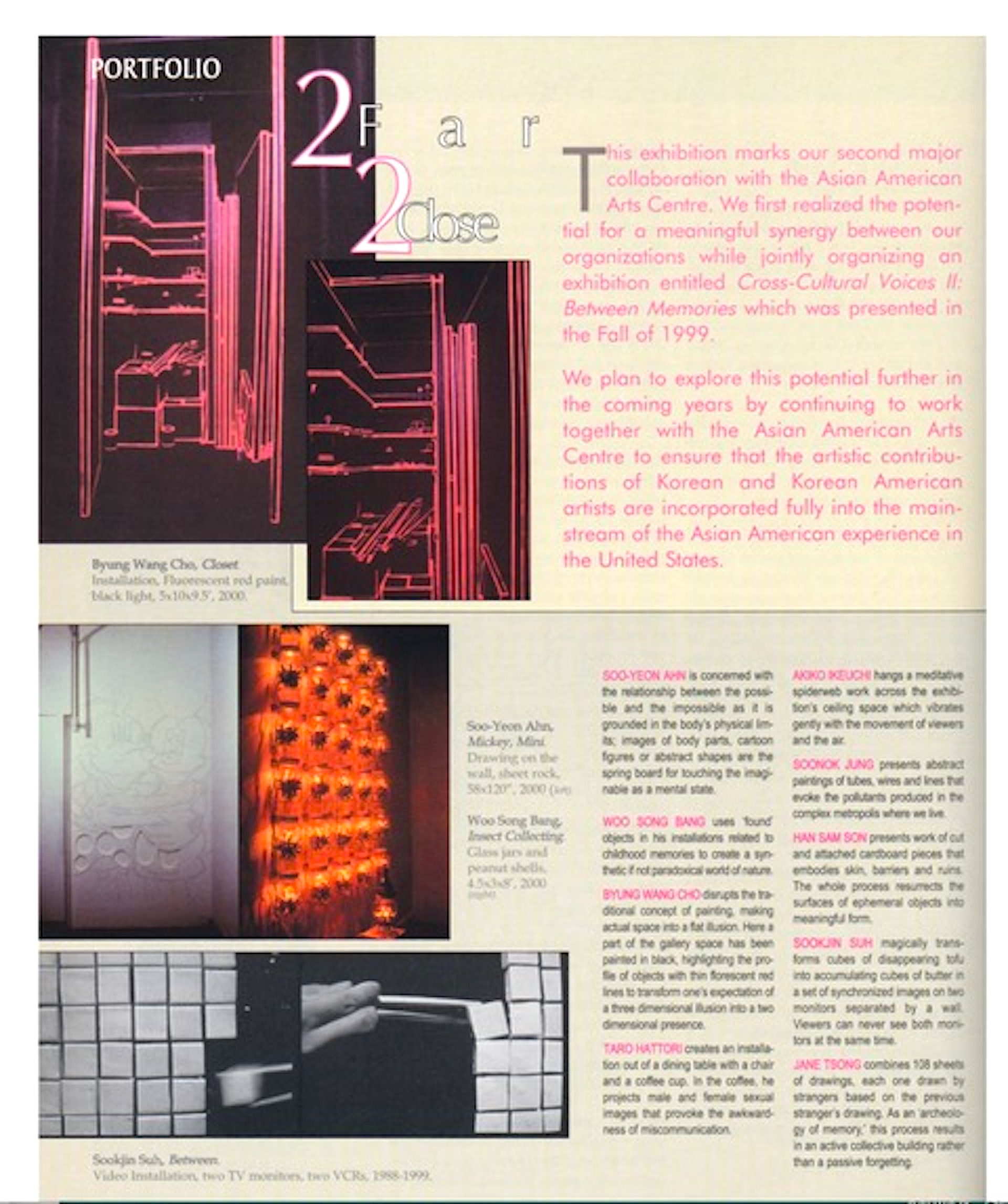

Economic dynamism in Asia in the late 1980s and 90s allowed for a considerable Western interest in Asian culture. As notions of how Asian strength might appeal to the Western imagination, terms such as the tiger and dragon were routinely used to represent the renewed postwar economic power wielded by the countries from the East, particularly during the last two decades. With the desired cultural package for Asia came the inevitability of a flawed skimming of the surface or a subconscious oblivion to the multivalent meanings that are embedded in Asia’s many evolving histories. However, the effort has been put forth to generate a more comprehensive and well-rounded perspective to demonstrate an engaged attention to the complexities of Asia.


A parade of large-scale exhibitions of Asian contemporary art passed through major New York institutions in the 1990s: Against Nature: Japanese Art in the Eighties (1990), Across the Pacific: Contemporary Korean and Korean American Art (1993), Asia/America: Identities in Contemporary Asian American Art (1994), Traditions/Tensions: Contemporary Art in Asia (1996), Inside out: New Chinese Art (1998), Out of India: Contemporary Art of the South Asian Diaspora (1997), and Cities on the Move (1998). As timely responses to the evident sociopolitical changes, these exhibitions strove to demystify Asian exoticism for Western viewers. In various degrees, exhibition organizers, including invited curators from Asia, carefully eschewed stereotypical designations. Many of the artists chosen to participate were given space at these major venues virtually for the first time. The ethnically based exhibitions naturally invite the viewer’s expectations of inherent eccentricities in the works from non-Western countries. Ultimately, the critical reception to such exhibitions always involved the debate over whether the works were too derivative of Western trends and inauthentic, or, too ethnic to pass muster against the contemporary art yardstick.


In the wake of postcolonial ideology, the West’s attention to “others” has shifted gears, and is seen as an attempt to stimulate a seemingly exhausted Western art history in the Modern and Postmodern lineage. Both the capacity and the need to bounce the Western self-concept off of something else, to set a point of reference, became profuse. It is crucial to note the subtle difference from the arguments in “Orientalism”—that the notion of the orient was a mere reflection of European arrogance and Western prejudice—as discussed by such authors as Edward Said. The realities of globalization and information technology update the East-West gap from one of civilization hierarchy to that of cultural difference. And while this is not an attempt to make a haphazard equation between the issue of Orientalism and the current proliferation of Asian or “non-white” contemporary art, the discussion of the subject has certainly illuminated some of the operative complexities of the climate cued by such buzzwords as multi- or trans-culturalism, globalization, and nomadism. The manifold intricacies become even more complex as one takes into account cultures fostering other cultures within, as in the case of numerous immigrant groups, including that of the diverse Asian Americans, contained within a vast nation such as the United States.


Being indigenous neither to “America” nor to “Asia”, Asian American artists have yet to be comfortably positioned in an international art scene that has of late championed artists of Asian origin. This is precisely due to the geographical uncertainty of their cultural identity, embodying an ill-fitted culture within another culture. The title of the exhibition organized by the Asian American Arts Centre, 2 Far 2 Close, zeroes in on this dilemma. As a community-based organization, the Centre was founded in 1974 with its commitment to promote the preservation and creative vitality of Asian American cultural growth through the arts and its historical and aesthetic linkage to other communities. The dilemma doubles when we realize the Centre’s mission has been to address the distinctive concerns of Asian Americans in the United States that go in two directions both within the very community itself and to the larger society. There is a difficult paradox in the simultaneous pursuit of preservation and assimilation. The Centre’s effort has always been to embrace the shifting state of “Asian American-ness”. The artists represented in the current exhibition 2 Far 2 Close reflect this posture by including nomadic/diasporic “Asian Asian” artists who recently moved from their native countries and have chosen to be based in the United States but reside here semi-permanently. The Centre’s programs have been all inclusive in this sense from the very beginning of its exhibition programs begun in the mid-1980s.


The construction of identity in every age and every society involves establishing opposites and “others”. As Said maintained, “the development and maintenance of every culture require the existence of another different and competing alter ego.” An individual’s self-concept emerges often when one recognizes oneself as separate and different from others. Cultures need to go through an analogous process and so must identify themselves through an alter ego. In other words, the need for an “other” is built into human nature at both the individual and collective levels. Now that the geographical border of culture is becoming rapidly fluid, the act of reaffirming cultural identity seems increasingly complex.


I have a vivid recollection of my own embarrassing and naïve surprise at my first encounters with Asian Americans when I arrived in the United States about a decade ago. They look Asian just like myself, but have Western first names, speak English without the slightest accent, and might be incapable of reading Chinese haracters. This unexpected and beguiling “foreign-ness” I felt from them was much greater than that of other Western people of different races. More than anything, this was “the” culture shock of my coming to America. It is imperative to recognize the sheer relativity of what appeals as exotic or different and to whom. As cultures increasingly fracture, the identity of the individual becomes further hybrid. And this hybridization of cultural identity is evidenced not only by artists, but also by art professionals who institutionalize it, and by the public whose embrace or rejection of it feeds the cycle of production--whether towards radical or mainstream ends.


AAAC’S ANNUAL SERIES OF EXHIBITION

By Robert Lee

Executive Director Curator, Asia American Art Centre


The Annual series of exhibitions began modestly, as a reformulation of a series started five years earlier entitled, "Ten Chinatown: First Annual Open Studio Exhibition." Five of these Open Studio exhibitions were held. Thus the Annual series is actually sixteen years in the making. The series was changed when, after five years, too few artists had their studio in the neighborhood and the idea for the annual exhibition had to be changed. How then write about the Annual series as an Arts Centre endeavor? Judging from hindsight may render one useful perspective.


The role of the Annuals/Open Studios in the Asian American Arts Centre's visual arts program was an opportunity to exhibit many artists, often quite diverse, eclectic, and innovative. It was, however, only one part of a larger effort to bring attention to a particular kind of artist who, we believed to a large measure had been overlooked. The work of AAAC began with visual artists in 1982 with the start of the Archive. This work was shaped in 1974 when the organization was named "Asian American" and again in 1984 by identifying artists as "Asian American". In this way we sought to raise the visibility of the presence of difference. Some of the artists in the first Open Studio show were Kunie Sugiura, Arlan Huang, Jerry Kwan, Martin Wong, Zarina Hashmi, Charles Yuen, John Duff and Tom Butter.


In the early 70's the disaffection with government policies, the Vietnam War and the Civil Rights Movement lead to the view that major institutions had left out a piece of American history and were not serving a distinct segment of the population. This demanded of people of color that they uncover for themselves their own story. The history of Asians in America was one of these. The Arts Centre chose to present and explore our community in the Lower East Side of New York. The concept, Asian American art, is both ethnic, cultural and political, a middle ground whose value awaits recognition. Asian American Art is in the middle of a river, so to speak, of political, cultural and artistic complexities. It is a way of looking at art that is not only Asian and not only American nor simply artistic, but a combination of these. Its implications require the choice of a different ethical stance; we chose community action.

"Diverse communities seek to legitimize their perspective on the generic American story. The master narrative of American history can no longer presume a singular cultural perspective, and the process has begun to reconcile the contradictions of its multifaceted populations, and the cultural visions which they embody."


Our moral tone in 1996 was high, and certainly a sense of righteousness continues to be a part of what underlies Asian American art. Participants in the Second Annual Open Studio show included Kazuko, Ai Wei Wei, Prawat Laucheron, Albert Chong, Toshio Sasaki, V.C. Igarta and Nina Kuo. The Arts Centre proposed a different American ethos. Its cultural stance was and is color consciousness, an awareness of self in the context of a cultural past. For once one accepts oneself as such, an individual of color has the basis to accept and embrace other individuals and cultures. Color blindness, an American ethos based on merit and equality, dispenses with difference and the cultural heritages of other peoples. From the Art Centreís view, this is neither desirable nor viable given demographic patterns. The multiple perspectives that now compose the American landscape and the global context can be accepted and recognized as a non-hieratic basis for dialogue and cultural development. Given this perspective, the phrase, 'culturally specific organizations' is a misnomer since for such organizations, specific cultural roots serve as points of departure to see and embrace the whole. In a world that claims universality while implementing market share and turf fights (prime victims of this are fragmented ethnic enclaves) this is criticized as negative separatism and a ghettoization. Yet by initiating this identity, despite efforts to dismiss it, the question of difference has grown to become one of the many ambiguities the contemporary world lives with, and a point of departure to shape a more viable society.


Our effort to establish a place for Asian American artists and their work helped exerted pressure on mainstream institutions to change and make the American public aware of cultural developments in Asian American communities if not those in Asia. Cultural activities in ethnic communities routinely were ignored; the public knew nothing and could know nothing of the press blackout on so-called race based exhibitions. The national effort to assimilate or be inclusive of minorities and/or sheer ignorance kept this policy in place. When major institutions finally recognized these developments and then adopted them in the early 90s, it was seen in Hispanic, African and Asian communities as the appropriation of the mission, program, and funding of community art organizations. This is partly why most diverse community institutions did not grow to mid size or become institutionally stable. Some of the artists in the Fifth Open Studio show were Arleen Schloss, April Vollmer, John Allen, Toyo Tsuchiya, Rashid Arshed, Paul Wong, Ken Hiratsuka and Hilda Shen.


What was it like in the early years? Its promise of growth, the energy of righteousness, the support and encouragement we received, Dance Theatre performers rehearsing in the next room, we were a start up with no where to go but up. It was a joyous time, full of energy, borne by faith and enthusiasm. The long haul set in when funds were cut, supporters got jobs, married and left, The idealism of the 60's had past, and the thrill of the 70's with all of Chinatown's new groups began to settle. In the arts if it wasn't resistance from Asian American political groups, it was the label of ethnic separatism that claimed it was unsightly, even un-American to put quality second behind race. For such critics, the story of ethnicity could not possibly be synonymous with the story of serious contemporary art. Participants in the AAAC Annual 1990 included Kip Fulbeck, Henry Cainglet, Kwang S. Lee, Sui Ying Hung, Stanley Nishimura, Sui-Kang Zhao, Lalitha Ananthanaman and Julia Nee Chu.


With the fading of the Asian American movement, with the obscurity and irrelevance contemporary art held for the survival issues of most Asian American families, without news coverage in the major New York press, enclave containment was as debilitative or more so as the blockade of Cuba. And our response was similar - to entrench our community ethics and make frugality a value instrumental in effectively and persistently making Asian American art a permanent if microcosmic fixture on the fringe of the City. Without, as one "chuppy" expressed it, critical mass, and shedding the conventional ideas of what it means to make it in New York, we sought to amass a history, an Archive and a track record of the presence of Asian American art for later generations to build on. Without a marketing budget to generate a large audience and thinking being "in", "making the scene" was unnecessary for those who would seek us out. We continued to plug away and do what we knew was right.


In this we were wrong. Being "in" in the capital of commercialism where rumors and hearsay snowball into successful stampedes is crucial in how you are regarded. The incommensurability of the visual arts when the written and spoken word in a hyper-politicized urban environment holds far, far more weight than what is felt. Even the gap between Asian American Studies & Literature and the issues and concerns of the plastic arts infused with Asian American elements remains wide. Without a voice, those on the fringe know well what it means to be neutralized, manipulated, when any other course save towing the line is simply not viable. The dilemma remains as long as powerful elements in America refuse to hear other modalities, insisting on a national identity and a hierarchy that does not give credence to multiculturalism as an important if not defining description of the US. Some of the artists in the AAAC Annual 1992 were Jackie Chang, Hyun-Mi Yoo, Sungmi Naylor, Yoshiko Shimada, Ava Hsueh, Sowon Kwon, Gaye Chan and Ela Shah.


So we dug in further, zeal turned into regularity, burnout turned into savvy, and innocuous community programs maintained a facade that allowed us to continue our focus on Asian American art. By appearing to become undefined, subliminal, even obscure, to promote and establish its presence, not as a threat but as a habit, a given, AAAC sought to be normal, a part of the scheme of things. In this process Asian American art became less an idea, an ideology and more the daily support of the concerns, issues, idiosyncrasies of a multiplicity of artists and their work. Crafting themes provided a context and a history, a critical perspective that, in the light of arts incommensurability, maintains a human voice while the art speaks for itself. The Annuals become theme-less and five person panels formed to select the artists, enabling a gathering where Asian American issues could be discussed. This was the experience of AAAC as we saw and felt it. Asian American art has come a long way since then, accepted now in many quarters. But it has far to go. Its unabashed complexion, obscured increasingly by shortsightedness, a reconciliation between the civilizations of Asia and the West, is inexorable.


A note by the curator Young M. Park in her catalogue essay for “Cross-Cultural Voices” held at Stony Brook states: "In an interview that was done on October 7, 1998, Gao Minglu, the curator of Inside Out at the Asia Society and PS1 mentioned that, although he tried not to choose many immigrant artists since the exhibition is about Chinese art, he had to depend on Asian American artists such as Wenda Gu, Xu Bing, Cai Guo-qiang, Lin Tian-miao, and Wang Peng for the major installation projects. In addition, of the sixty artists participating in the exhibition, seventeen artists reside in or were educated in the West; nine among these seventeen artists are Asian Americans." For many reasons, Asian Americans artists still go under-recognized for their significance in contemporary art developments.


Just as creating an art without relying on the marketplace is possible, so living a committed life dispite American societal conditions, is possible. An engaged life without thought of self gain is still a choice. In chosing the creative side of Asian American communities, how they are pulled apart in a thousand ways becomes obvious. However, to begin to listen and appreciate Asian American voices, is one way to bring them together. AAAC in Chinatown? Yes. Abidding while observing the siege on this crowded enclave, and on the growth nationally of an Asian American consciousness, brewing a body of work that will continue to spawn and feed the urge to create. AAAC programs continue.


What other conclusions can be made about the visual arts program of the Arts Centre and in particular, the Annual series? Judging them with hindsight is useful but ultimately this only creates another perspective, another trajectory, another plan, another conceptualization, another pebble in your shoe. From the past we can look for pebbles or see the ever-present genesis of the present moment. The Annuals are an effort to capture the openness of this moment. “Now” is a privilege happening before our eyes. To resist seeing them as past, to be reluctant to say ultimately what they were or mean is to celebrate them for what they are.


Many artists, since participating in Open Studio/Annual exhibitions, often early in their careers, have done well. Among these the following can be mentioned: Santiago Bose, Jackie Chang, Albert Chong, Theresa Chong, David Diao, Kip Fulbeck, Kenta Furusho, Wenda Gu, Yang-Ah Ham, Zarina Hashmi, May-Ling Hom, Arlan Huang, V.C. Igarta, Jung Hyang Kim, Woong Kim, Kwok Man Ho, Sowon Kwon, Amy Loewan, Toshio Sasaki, Peng Wang, Martin Wong, Paul Wong, Xu Bing, Charles Yuen, Zhang Hongtu, Sui-Kang Zhao.


Read more
Tuesday, July 3, 2018
Thomas McEvilley | Asian American Art: The Transitional Generation

AAAC recently rediscovered an unpublished article written by late art historian Thomas McEvilley (1939-2013). McEvilley was an esteemed art history professor at Rice University, a contributing editor for Artforum and a senior advisor for Trans. He also contributed to the catalogue accompanying Contemporary Art in Asia: Tradition/Tensions. Another of McEvilley's articles, "Negotiating Modernisms: Contemporary Asian Art and the West" from the 1996 issue of ArtSpiral, is available on our website.

"Asian American Art: The Transitional Generation" was written on the occasion of AAAC's 2000 exhibition "Milieu III: Color," featuring the work of Natvar Bhavsar, Venancio C. Igarta, James Kuo, Ted Kurahara, and Seong Moy. McEvilley discusses an earlier variation of this lineup, in which Yun Gee and Miyoko Ito were included instead of Kuo and Moy (Ito could not be exhibited due to issues with shipping). "Milieu III" was the third in a series of exhibitions, "Asian Americans and Their Milieu 1945-65," curated by Robert Lee. Due to lack of funding, the "Milieu III" catalogue, with McEvilley's accompanying essay, was never published. We present the essay in its entirety here, along with several images of relevant artwork.

Natvar Bhavsar, Akshyaa, 1992. Photo courtesy of Asian American Arts Centre

ASIAN AMERICAN ART: THE TRANSITIONAL GENERATION 
Thomas McEvilley 

1.

The theme of this exhibition, “Color,” refers directly to the confrontation of Asian artists, who often come from a black-and-white emphasizing visual tradition, with the emphasis in western Late Modernism--from Fauvism to Color Field painting--on expanses of bright saturated color.  It refers indirectly to the racial theme underlying the situation these artists have lived in most their adult lives.  

The artists in this exhibition--all in various ways “artists of color”--came to the United States during the period of Modernism, and their works are being exhibited here now in the period of post-Modernism. This situation is very different from that of artists who arrived in this country in the nineteenth or early twentieth centuries, and again from that of younger artists who have arrived since the revision of immigration laws in 1966 shifted preference away from Europe. Before the founding of the League of Nations at the end of World War I there was little opportunity for a non-western immigrant to enter the activity and discourse of Modernism, which was seen as a specifically western phenomenon not necessarily susceptible to being transplanted elsewhere.  The nineteenth century linkage of blood and soil meant that it could not be appropriate to an immigrant population either.  

In that era the Hegelian view of culture and history still held sway; each nation was said to have a national character which determined, and was revealed in its art and culture as well as in its politics and social structure.  Both national character and cultural tendency were regarded as linked to ethnicity, so each artist was regarded as irremediably fixed in his tradition; any move to get outside it would seem like a kind of betrayal of himself as well as of his national compeers.  As Sartre said in his introduction to Franz Fanon’s Wretched of the Earth, a member of a colonized culture who took a position sympathetic to the colonizers had nothing left, neither the identity he was born and raised with nor the identity he sought to acquire through imitation.  Neither will have him, and he enters a kind of no-man’s land.  This was the hard fact: a member of a colonized culture could enter Modernism only through an act of betraying himself, his family, and his inherited community values.  The idea of a national identity which should be puristically maintained collaborated with the closely associated quality of race to create unbridgeable gaps between the world cultures and peoples.  A Chinese artist might come to America and begin making art there, but it would have to be his traditional or inherited artistic direction that he followed. Virtually no non-white people were recognized as validly entering and practicing Modernism. 

This situation changed in the early twentieth century.  The League of Nations was one reason and the breakdown of intercultural barriers by the foundational discoveries of modern physics--such as Einstein’s theory of relativity, which unfolded from 1905 to 1915--was another.  Both these developments promoted a sense of the universality of the human situation rather than its separation into parochial enclaves. At the same time the period of “primitivism” was occurring, when Picasso, Braque, Klee and other prominent western artists awakened to the aesthetic presence of non-western art in their midst and received its imprint. As African, Oceanic and Asian art demonstrably influenced European artistic Modernism, the sense of the universality of human selfhood increasingly took the place of the old insistence on national character and identity. 

James Kuo, Composition #1, 1993. Photo courtesy of AAAC.
From that time until the end of colonialism in the generation after World War II, it was possible for persons of other cultures to enter Modernism and take on the supposedly universalized identity of the Modernist westerner--but the cost was high. One might not bear the stigmata of a betrayer, but still a certain abandonment, even a tacit renunciation, of one’s inherited cultural identity seemed involved.  One would have to turn ones back on one’s own education and begin all over again, learning the art history and the discourse and values surrounding it, and attempting to generate enthusiasm for them as one’s own.  In this period the great examples are the Bombay Progressives, who in 1947 renounced the Indian heritage in favor of adopting European Modernist approaches to art making, on the assumption that such approaches were not ethnocentrically European but were somehow universal, like the western science that applied in the same way everywhere and the western capitalism which, in the immediate post-war era, seemed about to do the same. The individual artist was still supposed to be puristic in his cultural makeup, but now it was an alien or adopted purism.  As the Indian or Chinese artist had been supposed to be puristically Indian or Chinese, so now, becoming a westerner, he was to be puristically western. 

Hiddenly, such an artist must have perceived himself to be a hybrid, aware of an almost secret level of earlier conditioning lying beneath the surface veneer of westernization. Only recently did this hybridity come out of hiding and announce itself as a new approach to the idea of an inclusive and universal society.  With the end of colonialism in the years between 1947 and 1976 it was no longer possible for the West to pretend that it was the only cultural presence in a world of strangely silent aliens.   Indeed, as post-colonialism produced its inevitable byproduct of postmodernist multiculturalism, the situation of hybridity became elevated to a new idea of the cosmopolitan; only he who has nomadically made his way from culture to culture, acquiring layers that were not hidden but indexed on the surface, could claim to be, as Diogenes called himself, a Citizen of the World. Hybridism, nomadism, decentering, and pastiche became the ideals of a new age of humanity.  Now it was possible for the artist to merge the styles of various cultures retaining the one into which he or she was born as the foundation on which the nomadic superstructure of a variety of relativized points of view was erected.

In many parts of the world which have not yet entered Modernism this program may seem out-of-synch. As W.J.T. Mitchell has remarked, the western postmodernist might be advocating decentering to one who is still seeking a center, offering postmodernism to one who still longs for the charisma of Modernism.  For those of a generation that remembers the truth of yesterday, the Modernist benediction may still seem meaningful.  

Hegel declared both Africa and Asia ahistorical; they had not yet entered history, it seemed to him, because history meant progress and progress meant a conscious use of one’s life to work toward the shared human goal of a universal civilization. Since Africans and Asians, in his view, did not contribute to the constructive work of progress, they did not share in the creation of the meaning of history--which was virtually the same as not even existing at all.  Like the birds and animals, none of whom participated in the historical work of Progress, they were a part of that pointless and endless cyclicity of sameness that Hegel called Madness.  Like the insane in general, they had no legitimate self or identity.  

V. C. Igarta, Title Unknown, 1983. Photo courtesy of AAAC.
2.

The artists in “Color” came to the United States in the second phase--after the League of Nations but before the end of colonialism. For immigrants of their generation the acquisition of Modernism as a new foundation for self-expression was a matter of pride; it not only offered economic success but also success as a person--entry into a community dedicated to the project of history and supposedly in tune with it. Each underwent a series of reshapings and redirectings in making the adjustment, and selected the elements of the contemporary western tradition that seemed most useful in terms of his or her past conditioning and the need to modify it. 

The oldest artist in the group, Yun Gee (1906 1963), exhibited between 1925 and 1939. He overlapped the pre-Modern and the Modernist phases, and enthusiastically and affirmatively plunged himself and his work into the Modern. His works from the 1920s and 30s show a precise and accurate sense of the aesthetic underlying the Modernism of his time.   Hints of Cubism share the surface with the perspectival illusion of deep space. Though the paints “holds the surface” it still is supple enough to open deep graceful holes into the space behind. In Park Bench II (1927) the dark thicket in the background is distanced by the bright and happy glitter of the yellow roadway; the fractalized or cubized bodies of the figures blend into and stand out from the interlocking paint meshes. The ages of Cezanne, Robert Delaunay, Leger and Picasso are blended with smoothness and sweetness. The pictorial surface is resplendent with difference--in tonality and distance--while clinging together as tightly as the skin of a peach.  In Street Scene (1926) humans carry on their daily activities beneath a sublime chaos of sky that seems almost El Greco-like in its implication of an unknown presence hanging over human life.  Though Yun Gee learned watercolor in China as a child, there is not much of Chinese tradition to be seen here. He has magically put off one selfhood like a robe and put on another to wear it with supreme comfort.  

Filipino by birth, V.C. Igarta began to exhibit his Magic Realist paintings in New York in 1938. Featuring moody young women--either white- or dark-skinned--seeming to concentrate their selfhood before a backdrop of natural forms, they verged on sentimental evocation of the non-western world as both lower than culture--that is, natural--and higher than it--that is, transcendent.  The non-western woman as a symbol of nature and the unconscious rightness of things is a Modernist cliche. Igarta’s later work evolved into geometric abstraction of high quality, though it appeared after the moment when geometric abstraction seemed brought about by an inner necessity of art history.  The paintings combine push-pull effects that gesture toward Hans Hoffman’s influence with a subtle look of color-mixing after the style of Joseph Albers in the semi-transparent overlays.  The planes are centered round the area where they interlock, pulling apart yet held together, with a balance of gentle but strong forces. 

Ted Kurahara, Triple Light Blue, 1984. Photo courtesy of AAAC                                                                
Ted Kurahara most directly addresses the theme of color which is a unifying subtext of the exhibition. Coming from a culture where economy of color-means was valued as one of the signs of artistic maturity, Kurahara, of all these artists, yields himself most fully to the late Modernist sense of the transcendent unity of saturated monochrome color.  The most successful works in these terms are the triptychs combining abstract expressionist thematics with those of Color Field and Minimalism, and based in their elegant edge -framing on Jo Baer’s work of the early 1970s.  Triple Mars Black (1982-83) and Triple Light Blue (1984-85) combine Baer’s elegant minimalism with suggestions of Barnett Newman’s hieratic iconicity of color. Like such African American artists as Joe Overstreet, Sam Gilliam and Frank Bowling, Kurahara continues making abstractions with an inner drift toward the monochrome after the mainstream of white western art history has left it as a milestone marking a turning of art’s path. The triptychs, with their threeness in oneness, gesture theologically toward the western idea of the Trinity, and toward such Modernist landmarks as Yves Klein’s Louisiana Museum triptych representing the trinity in Rosicrucian blue, red and gold.

Miyoko Ito (1918-1983) might be described as luxuriating in a restrained sense of color.  Her compositions, mostly based on the still life, have a powerful sense of illustration or design, as if she wanted to reveal her sense of the underlying harmony of things.  Like other artists of Asian extraction in her age group she was attracted to Cubism for the way it fitted everything together like facets of complex jewels, to Hoffman for the same quality as well as for his lack of fear of bright saturated colors, and to such soft Impressionist avatars as Dufy and Bonnard, for the intimate serenity of their view of life.  The prepared ground seems to exude the forms upon it, and to hold them together as a substrate lying beneath and unifying them. Her works achieved a high resolution in the mid-1950s in paintings such as Act II in the Dusk (1955) and several Untitleds in which gouache-thickened grey-greens and browns mesh like pieces of collage in an homage to the richness of evening’s muted colors.

Natvar Bhavsar (b. 1936) began exhibiting his work in the mid-1960s, when post-Modernism was just beginning in this country or just about to begin.  His work is rooted in late Modernism, especially in the poured Color Field paintings of Morris Louis.  Nevertheless, perhaps because of the beginning of multiculturalism in the United States with the Beat Zen movement of the late 1950s and the counterculture of the early 1960s, he also incorporated references to his Indian heritage, as a postmodernist nomadic artist might do.  Straining powdered pigment through a screen onto a canvas heavily soaked with binder, he creates what Irving Sandler has called “cloud like . . . continuums of color in which there are no recognizable subjects or discrete forms.”  The technique refers on the one hand to Indian cult practices involving the application of pure powdered pigment to various natural surfaces and on the other to the western Modernist worship of pure color as a vehicle of transcendent feeling.  Yves Klein--whose influence from Japanese artists such as the Gutai Group in the mid-1950s may have positioned him as a sympathetic figure to Asian sensibilities--had pioneered the practice in the late 1950s. More recently, Indian-born Anish Kapoor and American Lita Albuquerque have applied unmodulated powdered pigment to sculptural forms that suggest an organic sublime.  But closest in spirit to Bhavsar’s practice is the remark attributed to the Color Field painter Jules Olitski that what he sought in his paintings was an effect as of powdered pigment flung into the air and filling the space evenly yet airily before it began to float downward. Chinese and Japanese ideas of the Void and the Indefinite seem to create a link with the transcendentalism of Modernist abstraction.

Seong Moy, The Little "500", 1958. Color woodcut. Photo courtesy of AAAC
3.

The Chinese, Japanese, and Indian traditions have all produced magnificent schools of abstraction, both hard-edged and painterly, yet it is not their own traditions that these artists rooted themselves in for their drive toward the universal. Western abstraction had its own claim to universality, which had two foundations. One was the theosophical tradition of the mystical value of “pure color” which supposedly addressed only “higher” faculties.  This view underlay much of the formalist criticism of Greenberg, Fried and others, but was brought most glaringly into the open by Sheldon Nodelman. For artists whose early conditioning was Asian, this transcendentalism merged with elements of Taoism, Hinduism, and Eastern Buddhism. In addition, the point of abstraction, in terms of Modernist thinking about particularity and universality, was that one supposedly could not identify an artist’s ethnicity or gender by contemplating his or her abstract painting.  The abstractness of the work pointed toward the fundamental building blocks of nature which--like Plato’s “five regular solids” in the Timaeus--are prior to ethnic identity.  So universalistic abstraction functioned as a medium of exchange and recombination through which Modernism sought to go beyond ethnicity into an idealized or dreamed-up realm of superpersons who transcended particularity.  These superpersons were blank in terms of the differentia of culture and the body--but in being blank they were also closer to being white people than anything else.  In projecting outward its idea of universality, the West had projected outward its idea of itself, only slightly hidden. 

This was why Modernist idealism had an enormously dangerous potential that does not even need to be specified--it underlies many of the disasters of our century.  Still it possessed a certain nobility in its desire to go beyond difference.  The problem is that this desire was unclear, so its nobility went astray.  Even logic might show this. The path beyond difference might more fruitfully be sought in the pastiche of different traditions than in the elevation of one to the status of a universal blank. This proposed elevation was to be a form of the Hegelian miracle of Aufhebung or sublation, whereby something incorporates its opposite yet manages to become thereby even more purely itself.

Young Chinese artist Huang Yong Ping, who now lives in New York, once put a volume of western art history and a volume of Chinese art history in a washing machine; through the little window they could be observed coming apart and mixing and finally blending into a kind of pasty grey matter; now it all looked the same, though nothing had been removed or denied on either side. In this simple exemplum, the project of attaining a position beyond ethnic differences is not pursued by directly denying them.  First they are affirmed, then confronted with one another in an intercourse which in time blends them.   Nothing became more purely itself, because nothing else was denied its selfhood. This blending of particular differentia is a down-to-earth or nominalist approach as compared with the transcendentalist positing of a blankness that is not inwardly defiled by a admixture.  The transcendent blank of a mystical white canvas (“one white as one god,” as Rauschenberg said of his white paintings in 1951) is based on a denial of difference and an exclusion of it, whereas the indistinguishable mass of things blended together is based on the affirmation of difference--which it includes in an embrace so ample as to include its opposite too.  


Notes  ----------------------------
1. G.W.F. Hegel. The Philosophy of History, English translation by J. Sibree (Buffalo, New–York: Prometheus Books, 1991), passim.

2. Jean Paul Sartre, Preface, in Franz Fanon, The Wretched of the Earth, English translation by Constance Farrington Harmondsworth, England, and New York: Penguin, 1967).

3. See William Rubin, ed., Primitivism in Twentieth Century Art: Affinity of the Tribal and the Modern, 2 vols. (New York: The Museum of Modern Art, 1984) and see also letters sections, Artforum magazine, November 1984, February and May 1985.

4. See Thomas McEvilley, The Postmodern Transformation of Art, in Michael Kelly, ed., Encyclopedia of Aesthetics (Oxford: Oxford University Press, 19), 4 vols. 1, pp. 433-439.

5. W.J.T. Mitchell, Postcolonial culture, Post-Imperial Criticism. In Bill Ashcroft, Gareth Griffiths and Helen Tiffin, ed., The Post Colonial Studies Reader  (London and New York: Routledge, 1995), p. 477

6. Irving Sandler, Natvar Bhavsar: Painting and the Reality of Color (Sydney: Craftsmen House in association with G + B Arts International, 1998), p.8.

7. See Thomas McEvilley, Seeking the Absolute through Paint: The Monochrome Icon, in The Exiles return: Toward a Redefinition of Painting for the Post Modern Era (New York: Cambridge University Press, 1993, p. 9-56.  
Read more
Friday, June 29, 2018
Recognizing Tradition in Modernity: Recap of Yun-Fei Ji Panel Discussion with John Yau and Robert Lee

John Yau, Yun-Fei Ji, and Robert Lee at the panel at James Cohan Gallery
In celebration of artist Yun-Fei Ji’s recent solo exhibition “Rumors, Ridicules, and Retributions” at the James Cohan Gallery on 291 Grand Street, the Asian American Arts Centre organized a panel discussion at James Cohan on Saturday, June 9 that featured Yun-Fei Ji, art critic John Yau, and AAAC Executive Director Robert Lee.

To kick off the conversation, Yau interviewed Ji about his early life growing up in China and the development of his artistic and thematic sensibilities as Ji moved between various contexts on different continents over the course of his career. As Ji recounted his personal journey navigating childhood ghost stories, China’s political landscape, a master’s program at the University of Arkansas, and the New York City art scene, he corroborated the stark analysis posed by John Yau in the opening paragraph of his recent article in Hyperallergic: “[Ji] is a Chinese artist who isn’t just a Chinese artist, an American artist who isn’t just an American artist. When a curator at an American museum told him he couldn’t show his work because he is Chinese, he replied: ‘I am as American as Willem de Kooning.’... In the age of globalization and migration, both voluntary and forced, Ji is an artist who doesn’t quite fit comfortably into China or America.

As AAAC intern Amy Hong noted in a previous Artspiral blog article previewing Yun-Fei Ji’s exhibition and panel at James Cohan, the Arts Centre has supported Ji since the early days of his career by exhibiting his work on two separate occasions in the 1996 and ‘99—well before Ji became an internationally acclaimed artist. Reflecting on the question of identity, AAAC Director Robert Lee has emphasized that the Arts Centre considered Ji an Asian American artist back then and continues to see him in that light today. Lee maintains that Ji is an artist who “inherits the heritage of two or more major traditions, and understands the contradictions, paradoxes, and dilemmas of straddling multiple cultures as generative for renewal and social change.”

In the latter half of the 20th century, multiple generations of Chinese artists in China and the United States struggled with the issue of inhabiting an uneasy space between two cultures. Many of these artists looked upon China’s immense, rich artistic heritage as a burden; they resolved to become modern by rejecting centuries-old Chinese techniques and embracing wholly American styles of abstract expressionism, conceptual art, and minimalism. It is only within the past 20 years that a new generation of Chinese artists including Yun-Fei Ji has taken on the mantle of tradition once again, breaking new ground on ancient soil.

During the panel, Lee acknowledged these historical trends by raising the question of tradition and modernity in Ji’s work: How is it so easy for Ji to see himself as a modern artist although he uses traditional Chinese tools and methods? Rather than elucidate his internal mindset, Ji responded in a fashion that was as specular as his art: he reflected the question back at Lee, leaving the answer to the asker’s own interpretation. To Lee, then, Yun-Fei Ji’s art might be considered akin to a period film—in other words, Ji adopts a historical setting as a stage by which to address contemporary issues like gentrification and displacement.

In that vein, one audience member asked during the Q&A whether Yun-Fei Ji’s exhibition had been organized as a response to the controversy and community outrage surrounding James Cohan’s exhibition of Israeli-German-American artist Omer Fast’s solo installation August eight months ago. A representative of James Cohan Gallery clarified that Ji’s exhibition had already been scheduled months in advance of Fast’s exhibition.

Although neither Yun-Fei Ji nor Robert Lee weighed in on the question at the time, it goes without saying that the panel itself—which touched on Ji’s ability to connect themes of displacement and haunting across multiple cultures and social configurations—occupied a definitive space in relation to the issues highlighted by the Chinatown community’s reaction to Fast’s installation. By making a concerted effort to welcome Ji back to Chinatown and draw in community members for the event, the Arts Centre aimed to emphasize the value of the James Cohan Gallery as a contemporary art institution that can genuinely invigorate the cultural life of the community. Artists like Yun-Fei Ji whose works can span centuries and speak to a myriad of audiences are crucial to the AAAC’s mission of cultivating Asian American art and making it accessible to the world-at-large.

– Written by AAAC intern Jeremiah Kim
Read more
Wednesday, June 13, 2018
Miyoko Ito: A Search for Place


Artists Space’s recent exhibition of Asian American artist Miyoko Ito, “Heart of Hearts” (April 7 - May 6, 2018), presents oil paintings from the 1970s until her death in 1983. Ito was active from the mid-40s to early 80s. This important early Asian American artist should be recognized for her unique manner of visual expression that mediated questions of heritage and modernity.


Miyoko Ito, Island in the Sun (1978), oil on canvas. Photo by Bob Lee

The Asian American Arts Centre attempted to exhibit Ito with other Asian American artists in 2000 for the exhibition “Milieu Part III: Color.” This show was the third in a series entitled “Asian Americans and Their Milieu 1945-65,” curated by Robert Lee. We wish we could have exhibited Ito in 2000 as we intended. However, due to complications that arose during the shipping process, her work could not be included in the show. It instead opened with the five remaining artists’ work (Natvar Bhavsar, Venancio C. Igarta, James Kuo, Ted Kurahara, and Seong Moy). Among these artists, Ito’s use of color is distinct; her use of extremely vivid hues, analogous colors, and subtle contrasts is fresh and highly evolved. These sumptuous color schemes, in conjunction with her surreal compositions, contribute to the strange allure of her work. In a recently rediscovered article written on "Milieu III" by established art critic Thomas McEvilley, never published for lack of funding, McEvilley writes:

"Miyoko Ito (1918-1983) might be described as luxuriating in a restrained sense of color.  Her compositions, mostly based on the still life, have a powerful sense of illustration or design, as if she wanted to reveal her sense of the underlying harmony of things.  Like other artists of Asian extraction in her age group she was attracted to Cubism for the way it fitted everything together like facets of complex jewels, to Hoffman for the same quality as well as for his lack of fear of bright saturated colors, and to such soft Impressionist avatars as Dufy and Bonnard, for the intimate serenity of their view of life.  The prepared ground seems to exude the forms upon it, and to hold them together as a substrate lying beneath and unifying them.  Her works achieved a high resolution in the mid-1950s in paintings such as Act II in the Dusk (1955) and several Untitleds in which gouache-thickened grey-greens and browns mesh like pieces of collage in an homage to the richness of evening’s muted colors."

Miyoko Ito, Gorodiva (1968), oil on canvas. Photo by Bob Lee

Miyoko Ito was born in 1918 in Berkeley, California to Japanese parents. As a young child, her family moved to Japan, where she excelled at calligraphy and traditional landscape painting. In a 1978 interview with Dennis Barrie, Ito states, “Those five years [in Japan] are the root of what I am now,” indicating the continuing significance of Japanese tradition in her work. After returning to Berkeley at age ten, a decision made by the family due to her ill health, she struggled to learn English; in order to do so, she resolved to suppress her knowledge of Japanese. Although she continued to read in Japanese, she refused to speak it. Ito cites her troubled relationship with language as a factor in her development as a visual artist.

In 1942 Ito was sent to an internment camp south of San Francisco, the Tanforan Assembly Center, with her husband who was later sent to the Topaz Relocation Center in Utah; both internment camps held approximately 8,000 Japanese Americans. She received her diploma from UC Berkeley in the mail while at Tanforan. While it is difficult to directly relate her experience in the camps to her later work’s imagery and style, it likely had a profound impact. After a brief stint at Smith College, she moved to Chicago in 1944 to study at the School of the Art Institute of Chicago. She remained there until her death in 1983.

Ito’s work is marked by a precise use of color and extremely subtle tonal variations that are both soothing and disorienting. These abstract oil paintings feature ambiguous curved and geometric shapes that multiply evoke landscape, architecture, and the body. The frames of the canvases seem to open into various alternate interior spaces that simultaneously flatten themselves. In Tabled Presence (1971) the viewer looks into the interior of a box-like structure in the upper portion of the canvas, yet its contours do not logically correspond to the space inside; two tubes project from a wall only to transition into flat shapes, breaking the illusion of space. The entire structure, generally planar but unrecognizable, can also read as a kind of bust or portrait. This allusive, elusive imagery is hypnotic and mysterious; ultimately, her works resist easy description.

Miyoko Ito, Mandarin, or the Red Empress (1977), oil on canvas. Photo by Bob Lee

Her brightly saturated palettes, fusion of the geometric and the organic, ambiguous imagery recall Western movements such as Cubism, Surrealism, and Abstract Expressionism; in fact, Ito cites Hans Hofmann and Picasso as two major influences on her work. Perhaps her training in Japanese calligraphy and landscape painting can be seen in her extremely fine, carefully layered application of paint. It is also possible to read in her shifting indications of space a search for place, a reflection of the instability and geographical dislocations of her youth and early adulthood.

An excerpt from the 2000 press release for “Milieu III” reads:

“Asian American artists’ work reflects the struggle to respond to these conditions and their dual cultural heritage.  Asian American artists faced a choice.  They chose to affirm or revise, reconcile or ignore, embrace or deny these cultural sources.  Each of the artists in this exhibition carried forward various artistic goals. When seen as a spectrum of Asian adaptations reflecting the processes of diversity and hybridity, they betray, often inadvertently, a spacious geometry of a multicultural universe.”

Miyoko Ito’s work too can be read as a mediation of differing cultures and traditions that resulted in a unique hybrid of Asian American art. Despite Ito’s renown in Chicago, she did not achieve during her lifetime the broader recognition she deserves. Perhaps "Heart of Hearts" and BAMPFA's exhibition of Ito's work earlier this year signify the approach of a critical reappraisal of her work.

Written by summer 2018 intern Amy Hong

Links

For more information on Miyoko Ito: https://brooklynrail.org/2006/05/artseen/miyoko-ito
For installation views of "Heart of Hearts" at Artists Spacehttp://www.artnews.com/2018/04/25/miyoko-ito-artists-space-new-york/
For more information on Miyoko Ito: MATRIX 267 at the Berkeley Art Museum and Pacific Film Archive: http://theseenjournal.org/art-seen-national/looking-westward-chicago-artist-returns-home/
Read more