Friday, October 28, 2016
Chinatown Is Not For Sale- AAAC Executive Director Responds

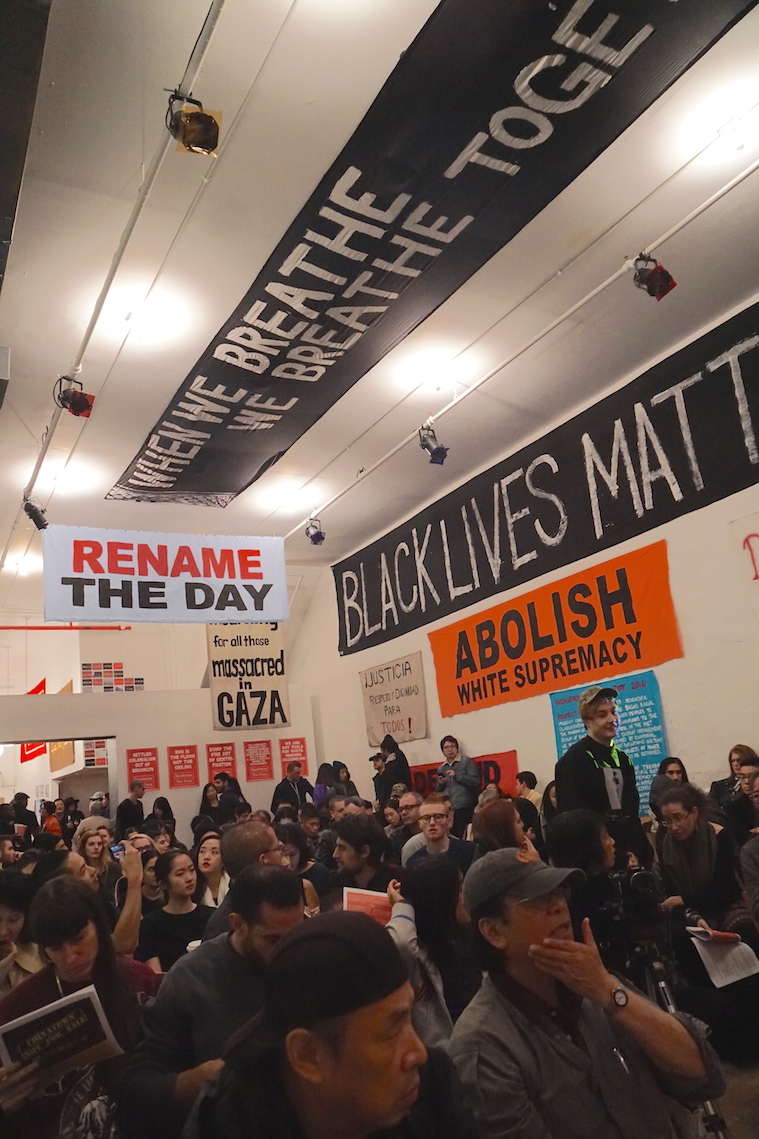
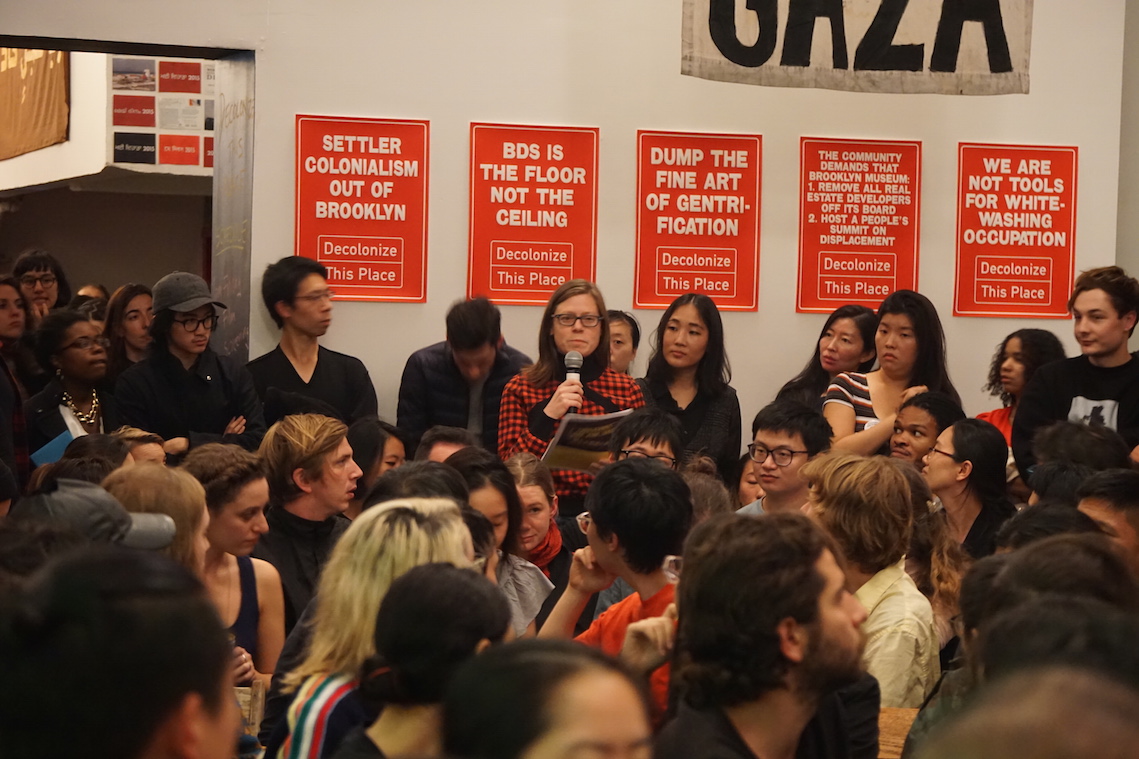
October 22, Artists Space, Chinatown Art Brigade, and Decolonize This Place brought together local residents, activists, gallery owners, and artists for a candid dialogue on the growing impact of art galleries in Chinatown. 

Asian American Arts Centre Executive Director Robert Lee was asked to be a respondent to the conversation. Post-event, he continues his response here: 

I want to thank the Chinatown Art Brigade for asking me to be a respondent to the panelists at the Chinatown Is Not for Sale event on Saturday, October 22nd, held at Artists Space on 55 Walker Street. My comments now might shed more light on this situation if I speak not as the respondent but more directly from the perspective of someone who has been working on contemporary Asian American Art for some time, and address the question Tomie raised-- the borders of Chinatown. I'm referring less to the physical borders than the cultural borders. In this way it may become more clear why the arts are central to Chinatown's growth as an important partner in the larger cultural life of New York City. 

Asian Americans, the next generation who are inheriting the dynamic Chinatown community, are clearly on the border, crossing and connecting and dissolving the border between Asia and America. Lower Manhattan's Chinatown is unique in that it bears all the markings both racially and politically of its long history in New York City, and even as a microcosm of China's immense past. New Yorkers and visitors who want to experience Chinatown may enjoy touching just the surface of this community, for it offers a brief glimpse into deep time, into a fragment of ancient time. Physically these few square blocks are actually a window into a vastly important encounter, perhaps far more important to the whole city than to the population who live within its limits. 

Recently I went to a five-day conference on Traditional Chinese Medicine. I was surprised for nearly twenty minutes by the opening address of the keynote speaker, who is the founder of this medical profession. I thought it was a lecture on the arst. How to look deeply and feel the art, whether it was a painting or a popular song, listening emotively, savoring every note. Taking time to practice, repeating this lesson several times, to be sure everyone saw every color, every stroke. This was a lesson for practitioners of the art of healing on how to be open, how to sense and feel their patients. They did not treat symptoms, for these were only messages from the body, living energies flowing through not the physical body, but the energetic body. This energy can be sensed; the vibrations can be felt in exactly the way art communicates.  

It is here on this border, on this frontier, where the patterns of quantum physics apply (Peter Russell, a physicist, also delivered a keynote), where the latest, most contemporary ideas meet ideas from tradition, Asian tradition. And one of the most vital ways to communicate such changes in the world we live in is the arts. This is precisely where Chinatown sits, where the break between modernity and tradition merge, their energies flowing into each other. To recognize the vital character hidden in Asian traditions is to remove the blockages, the stereotypes that hinder the flow of life, and the energies it embodies. 

Lion Dances during the Lunar New Year season may seem quaint, a tradition that is no longer practiced in most of China. If you saw it last time you may have noticed how those who watch it are rapt, many as if in a trance. Many can't take their eyes off what seems a merely auspicious ritual. The rhythms and the roots of Lion Dance, however, go back 500 years to the Nuo Masked Dances, which are still practiced in certain mountain cultures in China. And the Nuo masks go back 4000 years, perhaps to Neolithic times. Within the small borders of Chinatown are rhythms that touch on the roots of China. 
In this community where so many work and live together, some 4th, 5th, and 6th generation, with other more recent arrivals, the customs, manners, instincts and accents vary into a wide array. Yet they all retain a compatibility with each other. It is this immersive geographic cluster that is so New York, that is accessible to a broad public. We all know when we are in Chinatown. You can feel it. The multitude of street signs, the closeness of things on top of each other, the sounds of people talking, working, laughing, this is what attracts many to come, walk on its streets, stop, visit, stay a bit, feel the vibes. All that we sense is part of the human architecture, part of the energetic body of Chinatown, and its borders permeate beyond its physical limits. The essence of Chinatown is not physical. And to encounter it in food, Buddhism, martial arts, churches, streets, language, neighborhoods, music, dance, brushwork and new art is to touch a vital part of what it means to be alive, to be a New Yorker. 

We have all experienced it. It's time to become conscious of it.  

It's through the arts that Chinatown can become conscious of its role in the city, be the partner to keep the city and its culture not driven, not rushed, not crazed, but thriving, energized. It's not just the income, the jobs, the housing, the parking we want. Clearly these are part of it. But the vital energy of living culture is what we want. When we come to recognize this, we can take steps to nurture this and protect it.  

For example, what has been offered at this event is a map of what could be interpreted as a foreign invasion, a Trojan horse for gentrification. Yet two of these galleries, Whitebox and 47 Canal, given we understand better their cultural mission, their purpose and compatibility with the cultural future of an energized Chinatown, and given their stated interest in working with this community, are both assets in moving our community forward. Whether other galleries have a direct interest in Asian American art or China's art, or a cultural phenomenon in Asia, or a cultural question even here in the states in which we as Americans are still deeply implicated, the energy they bring can be compatible with our goals. The energetic body of Chinatown can help envision/formulate a proposal to the local community board for an advisory role in screening galleries seeking to relocate here. With the city's blessing in acknowledging the value of a vital energized Chinatown, galleries can make a presentation of their cultural mission, what kind of cultural energies are important to them, what relationship do they seek or have with Chinatown's cultural future. These and other questions, like - are there already too many galleries on this street? Then our community can weigh in on how Chinatown develops. Such a process in some sense might even be implementable retroactively. (With the city's blessing, other steps can be taken on the housing front, and I'm guessing, even on the small business front.) 

The physical borders of Lower Manhattan's Chinatown are quite limited. However, what the city, the state, the East coast, and even the country risks losing to gentrification is profound. Chinatown is in the mind. It is what it means in no small measure to be a New Yorker, to be living in contemporary times. Not to be able to touch and feel its essence would be a deprivation, a loss to what makes New York an attraction. With the growth of digital culture, more internationally are becoming aware of the vitality in our neighborhoods.  

Become conscious of the flow of cultural energy, its role in the life of Chinatown. Then we can take actions that will energize everyone.  

Robert Lee 
Asian American Arts Centre  


Tomie Arai of Chinatown Art Brigade
Artist Liz Moy
Juan Puntes, founder of White Box 

Margaret Lee of 47 Canal 


Betty Yu of Chinatown Art Brigade 
Peter Kwong


Read more
Friday, October 21, 2016
Chinatown Art Brigade Leads Environmental Tour of Chinatown

October 9th, CHINATOWN WALKS. Hosted by CALL, City As Living Laboratory.
Chinatown Art Brigade (artists) and Samuel Stein (urban geographer) will lead a "Placekeeping" Walk in Chinatown to help shift public perception of local environmental issues that go beyond pollution, dirty streets and garbage. The walk will highlight the environmental effects of gentrification and massive construction on the Chinatown quality of life. The walk will be led by Chinatown Art Brigade's co-founders, 3 native New Yorkers with deep roots in Chinatown along with Samuel Stein, an expert in housing and public policy.
Jean Shin (artist) and Robin Nagle's(anthropologist) WALK will highlight the often invisible systems and economies that are part of the ecology of Chinatown. Shin and Nagle will focus on recycling work done by canners, patterns of consumption, and hidden infrastructures of waste streams and labor.
(L-R) Mansee Kong, Samuel Stein, Tomie Arai


 Artist Jean Shin introduces the crowd to a man who runs a bottle-collecting stop in Chinatown around St. James Place. There is an estimated 5,000 women in Chinatown who dig through trashcans to collect bottles, which they sell for a five cents each to a "middle-man" (above), who in turn sells it to other states.


A participant speaks about the New York Department of Sanitation. 
Read more
Multiple Exposure: Desire, Accumulation, and Transformation

Multiple Exposure is a group exhibition featuring works by Yaloo (Ji Yeon Lim), Kira Nam Greene and Soi Park, the three AHL Visual Art Award winners of 2016. 

"From digital video to painting to photography, the three artists employ vastly different media and process of working. However, they all share a common theme that touches upon desire, accumulation, and transformation in exploring various cultural nuances.

"Whether capturing a slice of contemporary life through the lens of media saturated Pop culture or the nuanced balancing act of immigrants trying to reconcile who they are at the intersection of contrasting cultural and sociopolitical economies, the works in Multiple Exposure present intriguing accumulation of multifaceted interpretations and perspectives" 

- Eun Young Choi, Curator & Director of Programs, the AHL Foundation 
(L-R) Artist Kira Nam Greene and curator Eun Young Choi

Artist Soi Park  and her series Young Jeong Sajin (The Funeral Portrait) 
Film still from artist Yaloo (Ji Yeon Lim)

By Kira Nam Greene 
Mello Jello, by Kira Nam Greene, 2016
 Watercolor, gauche and colored pencil on paper mounted on panel 

By Kira Nam Greene 


Read more
Tuesday, October 18, 2016
Does Chinese Civilization Come From Egypt?

In response to the article "Does Chinese Civilization Come From Ancient Egypt", AAAC ED Bob Lee says: 
  
  This story of Egypt as the prehistoric source of China does participate in political motives as well, to use archaeology to undermine the ageless enduring notion of China and thus its formidable political prowess. Perception in politics is everything.  
  
  In a TV program on PBS The Origins of Civilization, historian Michael Wood wrote about the ‘Barbarian West’ - a perspective on the Middle Ages which could be taken as having a similar intent. Many moons ago in Hong Kong there was an organization whose long term goal was to develop evidence to prove Chinese culture came from Southeast Asia. Despite all of its minorities, the coherence of a singular set of cultural notions is remarkably impressive. To attribute this and place this development at anyone other than at China's door holds little credibility.
  
  DNA indicates Chinese people originated in Africa which I can accept. I don't know if this also can specify approximately how long ago.  The controversy about Egypt as the source of China however is likely to remain a controversy for a while. In terms of the cultural aspects of this question, what we know of its culture at this stage of knowledge production has distinct characteristics quite apart from those that constitute the profile of Egypt. I don't consider this issue implying these two cultures are in some fundamental way identical. Perhaps related, but how related has to be developed. 

 That traditional China has a unique culture and its presence midst the global family of cultures carries a special importance for us all. I don't believe the question of Egypt significantly impacts this understanding. How China's culture embraced the world has a unique stance, direction, tone, evolution and character.  This cultural knowledge may be enlarged but significantly altered, that's hard to see as possible, given the limits we all live with. 
Read more
Friday, September 30, 2016
Special Meeting in Chinatown

A special meeting of Chinatown Working Group (CWG) was called by the Community Board 3, bringing together members of the Department of City Planning (DCP). It is rare to have the DCP come to talk. The community is very upset after working for 8 years to produce 197a plan, then having the city refuse to look at it. Now there is an agreement that CWG will change the plan to 197c plan, so they’re only looking at certain portions of the plan (3 portions). They now want to hear from the community about recommendations so that DCP can begin to process it. 


Edith Hsu-Chen, DCP 
Manhattan Borough President Gale Brewer


An eloquent speaker from Community Board 3 

Margaret Chin 
A noisy demonstration out on the street began early by some of the more left leaning community groups that have been participating in the last several years of creating the plan. After some clarification of what the purpose of this meeting was, a number of the Community Board 3 members spoke of how much they support the CWG plan and how they refuse to be forced by DeBlasio’s DCP department. Some say it’s been 6 years of work. Whether it be 6 years or 8 years, it is scandalous that the city would sit by and let Chinatown work all those years and now refuse to examine the whole plan. Their explanation is that it will take a number of years just to really process the sections of the plan dealing with the local Chinatown zones. And it would simply take too many years to cover the other sections of the plan that deal with outlying areas. 

Unfortunately this includes the waterfront, where major construction is underway. DCP’s explanation for why there are no regulations for low income housing requirements along the waterfront is quite obscure, but apparently DCP staff are locked into the regulations of how the city requires R10 to be up zoned to MIG (don’t ask me what that means or if it’s correct) status. However, that’s the first explanation from the horse’s mouth I ever got in 8 years. Some groups will hate me for it, however, it’s clear that DCP staff are working within their own limitations. The outcry from some of the members of the Community Board 3 on stage is that this opportunity to have this rare meeting and not discuss all sections, particularly the waterfront, which itself could totally transform Chinatown, is a bureaucratic way to fail in addressing the need to save Chinatown and zone it adequately. 

By 8’ o clock, when the meeting ended, with some sense of having been productive, the City, the Community Board 3, and those of us who have stuck through  so many years of giving time and effort to Chinatown’s 197 plan, went home outside PS130. As I left, many of the key people were still standing at the front of the school, discussing all the issues. 

Amidst all the protest and confusion, I was able to insert into the discussion how the arts can bring greater prosperity to our community. 

I thank Margaret Chin for staying there for the complete meeting, even into the night, as she has done since I’ve known her for so many years. 

- Bob Lee, Executive Director of AAAC
Read more
Friday, September 16, 2016
AAAC Presents First Responders: An Exhibition by Yang Yi

Yang Yi and AAAC Staff 
Artist Yang Yi with local firemen


Ben Hom, firefighter who donated a talisman he found in the debris of 9/11 
Brenda Hom 


The Asian American Arts Centre presents “FIRST RESPONDERS”, a solo exhibition featuring the work of artist Yang Yi 杨亿. Presented in collaboration with Chinatown Soup and in partnership with Chinatown Partnership Local Development Corporation - CPLDC. This is a special exhibition to mark the anniversary of this moment in our nation’s history. AAAC is proud to present this body of work as both a commemoration and celebration of the American spirit embodied by all New Yorkers whose response to the events of that day will forever mark our national memory. It is fitting that as Americans we should find an immigrant whose remarkable skills and devotion gives to us the fruits of his heart and his labor.
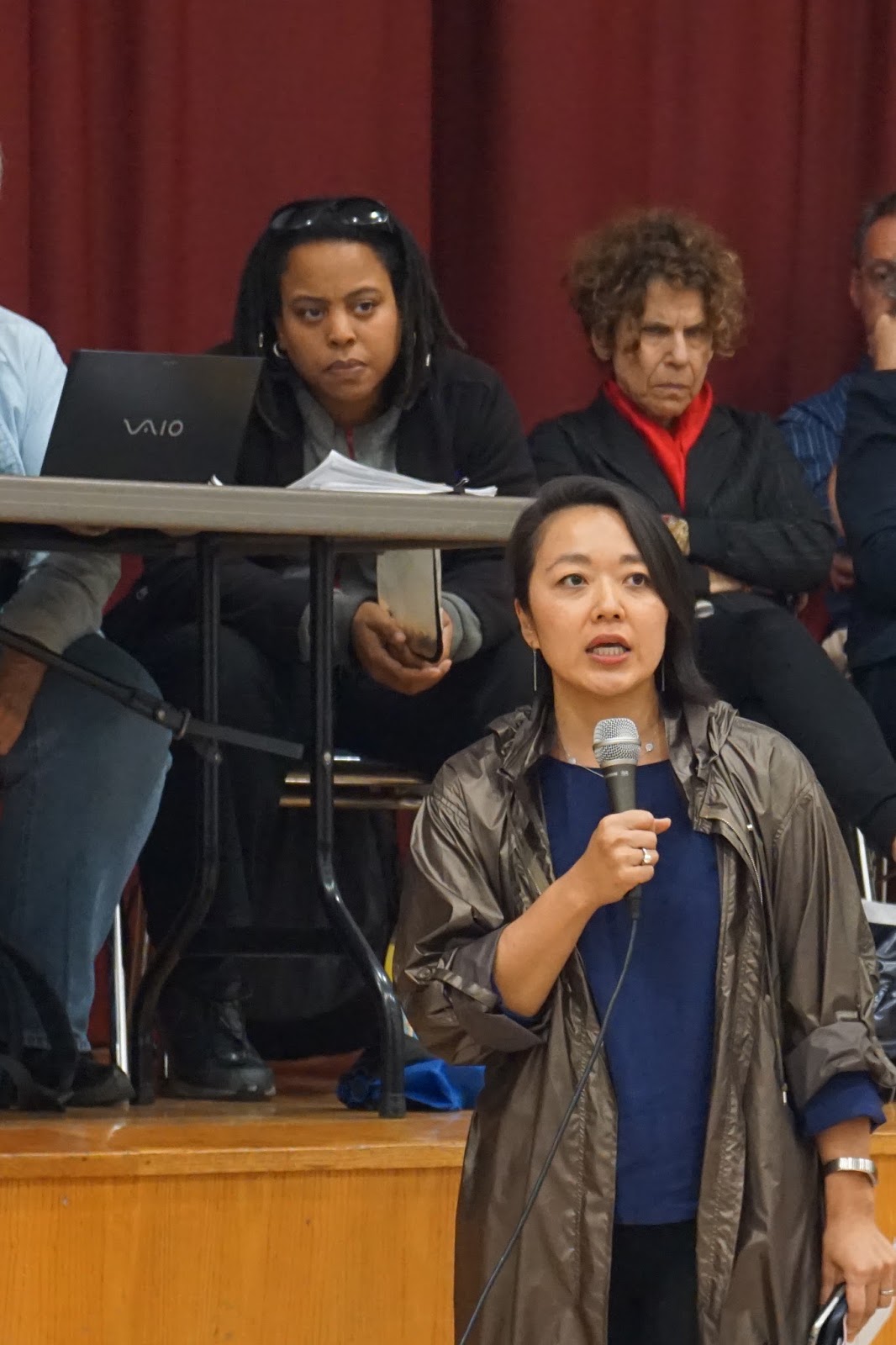
Yi’s pentaptych took five years to complete, gives tribute to the brave members of the FDNY and paramedics, featuring all 343 faces of the first responders who were killed at the World Trade Center 15 years ago. Yi’s work has struck a chord with the firefighters who have previewed it, and the Asian American Arts Centre welcomes the opportunity to share his work with all New Yorkers, visitors to the city, and to the Asian American community.

About the Artist Yang Yi, 59, came to the United States from China in 1995 where he soon made a living drawing portraits in Central Park. Following the 9/11 terror attacks, many people would show Yang Yi photos of their loved ones who had lost their lives, asking him to create a portrait. In 2010, Yi saw a mural on the side of the Flushing firehouse that inspired him to paint a tribute of his own. Working out of his small apartment in Flushing, Queens, Yi took five years to create the five canvases presented. A portrait artist by trade, Yang had to care for his family while taking time off from his usual work to create a tableau of events and symbol’s from the city’s difficult days. Images of debris-covered survivors, the American flag flying above the wreckage, along with moving portraits of every individual face.

The exhibition is expected to travel later this year to Sumei Arts Center’s firehouse in Newark, NJ. Updates on all future events will be posted on AAAC’s social media outlets, including a link to a Kickstarter for this commemorative project.


Read more
Tuesday, August 30, 2016
A Day in Philly: Robert Lee Tackles Cultural Equity in the City of Brotherly Love


Robert Lee, Executive Director of AAAC, recently spent a day in Philadelphia and found the city to be thriving in passion and art. Here are some pictures from his trip in Philly!

                            
I came across a Korean Dance Troupe from Korea, traveling through the US to connect with American people through traditional Korean culture. Beautifully danced, and the music was well done. Perhaps they timed it to be here during the DNC? 
...


Philadelphia has a Chinatown Gate. NYC Chinatown has been pushing for its own gate for years, ever since the BCLDC was established. AAAC exhibited a woman architect from China, Chen Xiao Rui, at that time who could build and ornament such a gate in the most authentic manner. NYC Arts Commission refuses permission - even though CCBA has money reserved to build it - because they are clearly prejudiced against traditional architecture. Chinatown seems to be thriving. Asian Art Initiative is on the adjacent outskirts along the highway, unfortunately not open on a Sunday.
...


I can only describe this mural as quite odd, one man in a submarine looking through a periscope, the other with a beard with beads praying. The small window or frame is on a perpendicular wall so this view seems like the two men are facing each other, both oddly in their own world, yet peering at each other.  
Perhaps just a property owners sponsored mural, pleasant  yet ....
                       

This was the only community or artist created mural that had some sense of NYC
      

I biked a bit around South Philly. Saw the neighborhoods and saw a number of murals, usually large like this one, never much graffiti or expressions of common people like we have in NYC. There are murals posted here that reflect a very different city with a different city mural program at work. Some murals are quite ambitious and elaborate, others I can only describe as quite odd - an unknown civic energy at work.

Meg Salesman apparently was commissioned for a number of these huge elaborate works. I see no graffiti anywhere on them.
...


Near the location where the DNC were gathering, a demonstration/ritual took place. After seeing several street actions and incidents in Philadelphia, the significance for Americans of this "DNC" was something that clearly touched them. The meaning and the hope for their country was deeply felt, enough to move many to take the actions they did.


"I stand by my sacred ground." A demo ritual on the streets of Philadelphia. Yes, there was an Asian American women who spoke passionately in this circle. She is in the blue long skirt near the sign.
...


Small local farmers sent their representative to be present at the start of this national moment. To show support he gave us his card - www.justriders.org. I just had to make sure I did not move my bike too close else she (the alpaca) would not like it.
...


The march down South Broad Street was quite long and filled half the street except for the beginning which was pushed to the sidewalk by a row of bike cops. I noted there were few Blacks and Asians scattered among the marchers; some, like the woman pictured, were media people. When I saw on the side a black family with several children standing on the side as spectators, I felt this was clearly a cultural event of the mainstream.

Jennifer Fredrich is the artist's name, written in the left corner of this artwork displayed before the thousands gathered began their march down South Broad Street on Sunday. It was too large to be carried in the march without a mobile framework.

There were many different people who took part in the march down South Broad Street. This was one of the more unusual people. Unfortunately, I lost track of him in the march and did not bump into him again until my bus was about to leave late that night. Aside from "Feel the Bern", there were appropriate sayings for many political leaders' positions.
...

So many streets look like long alleys, and the buildings are mostly two stories.


In the window are what looks like home made crosses and an arc. So may ethnic peoples have moved here. From one Indonesian restaurant I learned that several thousand Indonesians came in in 1998 after the massacre of Chinese there. 


This family scene reminded me so much of Newark in the old days.

This gathering is not too far from the Cambodian Church


An exceptional corner home
A few of these narrow residential streets did grow their own greenery
This is the Asian American Buddhist Association. Below is a view of a mural painted on the side of this building facing a large parking lot and a major road so this quite visible.
Several small squares with fountains and public benches are here and there. This one you can see a blue donkey painted with a Puerto Rican flag...
and some casual musicians 
Translation Please!  In one of the better parts of So. Philly some people were  painting this calligraphy and preparing to make a film with a large camera. Perhaps a political statement? If so then this was the only graffiti I came across with some political/social intent.  
The Philadelphia Acadamy of the Arts, a seemingly crashed plane serves as their mascot stuck between its narrow frontage. Prestigious art schools here. 
A city sponsored art fountain for children

Read more